WeChat Article · One-click CopyCopy, then paste into the WeChat editorCopy article
WeChat Article · One-click CopyCopy, then paste into the WeChat editor
WeChat Article · One-click Copy
Copy, then paste into the WeChat editor
YUANMU · WINTER XINJIANG 03 / ALTAY
Some come for a piste. Some come for snow. What stays with you may be the unfilled time: a night in Altay City, a second morning in Hemu, and the quiet of Kanas after a hard day on the mountain.
Hemu in winter. In Altay, the first real question is not how much farther you can go today, but whether you should stay where you are.Image: Leeinm / Wikimedia Commons / CC BY-SA 4.0
Most stories about Altay in winter are built around two verbs: see snow and ski. But a route made only of resorts can reduce Altay to one vast sports ground. A fuller journey puts skiing back inside the place itself: land in the city, sleep in a village, give one whole day to the mountain, then let Kanas take the speed out of the trip. Nothing is lost. Each kind of time is simply given its own place.
On a first winter trip to Altay, there is a temptation to bring the climax forward. You land with ski trousers, gloves and goggles in your luggage. The ridges are already white. The obvious next move seems to be the biggest, farthest resort.
Altay City offers a better opening. Jiangjunshan sits close to town, tied to hotels, restaurants, equipment and transport. Xinjiang’s recent winter planning still places Jiangjunshan, Jikepulin and Koktokay at the heart of Altay’s ski landscape. But for a first-time visitor, the opening day does not need to settle which resort is “best.” It needs to settle you into winter.
Fit the gear properly. Meet the instructor. Spend enough time outside to understand the cold. See what a full day on snow does to your legs. Some people finish wanting more speed. Others realise the next day should be slower. That knowledge is worth more than squeezing in another mountain.
A good opening does not rush the climax. It lets you enter the season. In that sense, Jiangjunshan is a doorway: the city is still behind you, but Altay winter has already begun.
The trip changes on the road from Altay City to Hemu. In town, snow belongs to streets, headlights, ski lifts and the evening. In Hemu, it settles on roofs, slopes, forest edges and the empty ground between houses. You are no longer going out to “see snow.” For a while, you live inside a place rearranged by it.
Hemu is easy to compress into one image: timber houses, smoke, hills, white ground. Arrive at noon, take the picture and leave the next morning, and the village can remain a view. The second morning changes that. The first day is about finally being there. The second gives you time to notice where the light enters, when the lanes go quiet, when to walk out and when to come back in.
That is why two nights are not simply a hotel choice. They turn a sleeping point into a real stay. You can often tell what a route values by where it chooses to spend the night.
Once the night belongs to Hemu, Jikepulin no longer has to carry the whole meaning of the destination. Skiing can become the strongest chapter of the stay. The village remains the world around it.
Hemu in December 2025. In winter, depth often comes not from adding another stop, but from allowing the same place to greet you twice.Image: Pazakui / Wikimedia Commons / CC BY 4.0
Jikepulin is worth a trip in its own right. If skiing is the main purpose, staying at one resort for several days — or much longer — makes perfect sense. Fewer transfers. Less luggage. More time on snow. It is a clean, focused kind of journey.
A mixed winter trip asks a different question. If not everyone is a skier, and if you also want Hemu, Kanas and the life of Altay itself, should every day repeat the same intensity?
Place Jikepulin in the middle of a two-night Hemu stay and the rhythm becomes clear. Day one enters the village. Day two belongs entirely to the mountain. Day three moves on. The ski day becomes a peak without swallowing the whole journey.
A climax needs contrast. If every day tries to be faster, higher and fuller, very little is left to remember as the high point.
Opening dates, piste access, lift operations, ticket prices, night skiing and shuttle rules for the 2026–27 season remain short-cycle information. They should be checked against current resort notices, not frozen into a promise made in September.
ENTER|Altay City · JiangjunshanMeet the snow — and your own body.
STAY|HemuGive the same place a second morning.
PEAK|JikepulinGive one complete day to skiing.
SLOW DOWN|KanasLet speed fall away. Let space return.
Sometimes a journey needs one simple move: stop repeating the thing you have just enjoyed.
Moving from Hemu and Jikepulin to Kanas can look like a move from “something to do” to “nothing to do.” Skiing has pistes, lifts, speed and a clear beginning and end. Kanas in winter is closer to subtraction. Mountain, forest, lake and river remain, but there is no need to keep completing tasks.
That is exactly why it belongs here. The first days ask the body to work: dress, climb, ski, descend. Kanas returns the journey to walking, looking, waiting for light and feeling the cold. Intensity moves from sport back to space. Winter itself becomes audible again.
Kanas is therefore not a sightseeing add-on after the skiing. In this kind of route, it is the true close: not another climax, but a place for the journey to become quiet after one.
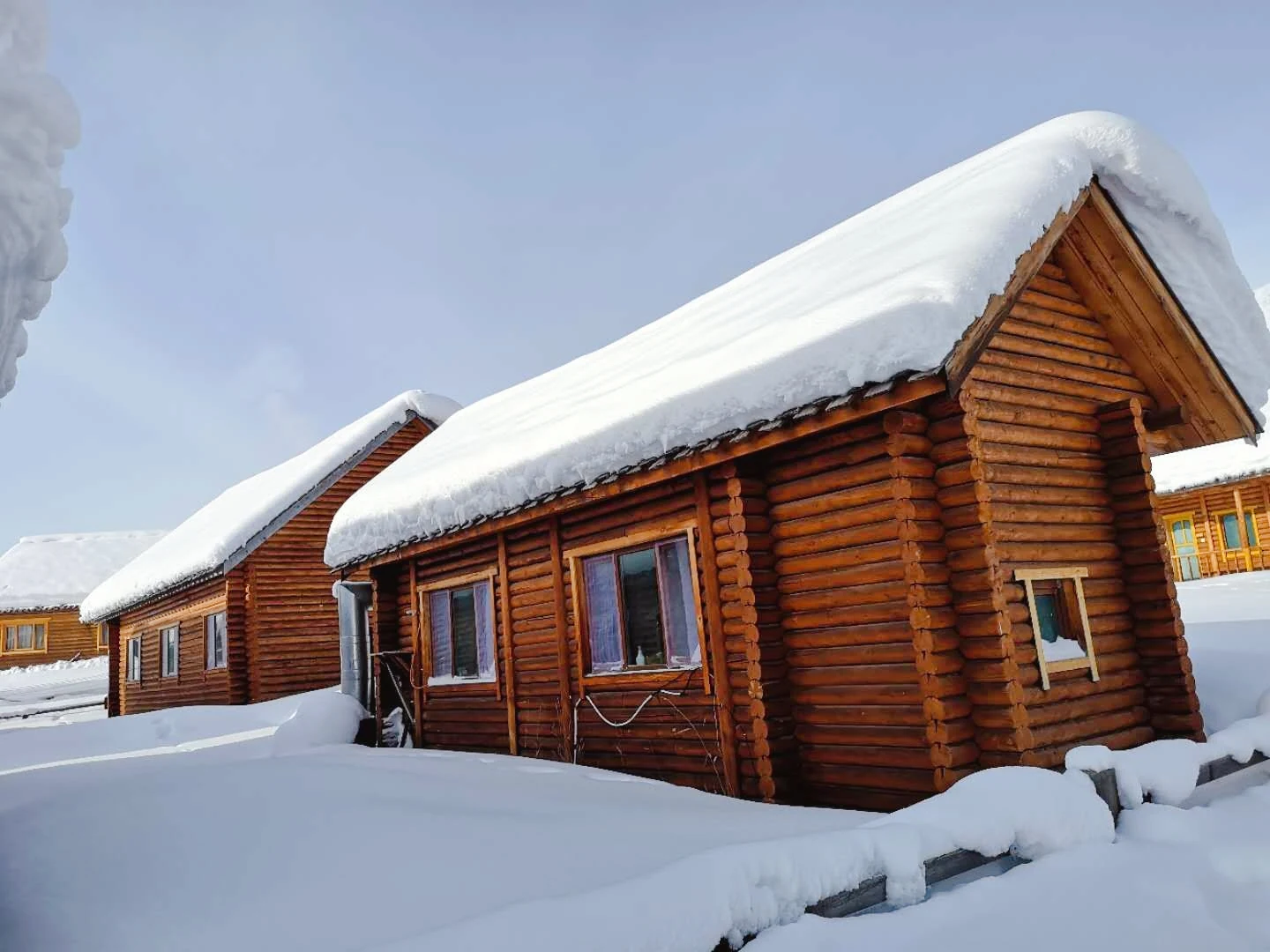
Snowy cabins in Altay Prefecture. Once speed recedes, winter turns back into timber, forest, valley and light.Image: Huangdan2060 / Wikimedia Commons / CC BY 3.0
Summer in Xinjiang encourages efficiency. The days are long. The road is still open ahead. Once you have come this far, one more stop always seems possible. Winter slowly dismantles that logic.
Cold makes dressing slower. Skiing creates a real need for recovery. Mountain weather adds uncertainty to roads and shuttles. Shorter daylight changes what an afternoon can hold. Xinjiang’s 2026 winter safety analysis also highlighted peak crowds, higher-risk snow activities, lift operations and unmanaged outdoor exploration as risks requiring active control.
So half a day with no “attraction” is not necessarily empty. It may be recovery after the mountain, a buffer for weather, another afternoon in Hemu, or simply enough time to dry wet gloves and eat dinner without watching the clock.
Space is not wasted time. It is both a safety margin and the room in which winter travel becomes humane. The expensive hours in a winter itinerary are often not the ones that add places. They are the ones that remove panic.
Putting Jiangjunshan, Hemu, Jikepulin and Kanas into one journey does not make the journey right for everyone.
If the only goal is to maximise ski time, the better plan is usually simpler: choose the resort that suits you, choose the right accommodation and stay there. Fewer transfers. Less luggage. More energy and money spent on the thing you actually came to do. That is cleaner and more honest.
But if this is your first winter in Altay; if not everyone in the group is an experienced skier; if you want snow sports without giving up villages, forest, lake country and the life of a northern city, a mixed structure can make more sense.
Nor should it be sold automatically as “easy for seniors” or “effortless for families.” Cold, roads, walking surfaces, equipment and ski intensity all need to be judged against age, fitness and current weather. The best route is not the one that includes the most. It is the one that fits the people travelling it.
Winter destinations are easy to describe with numbers: ski days, resorts, villages, centimetres of snow. The memories that last are usually less orderly.
It may be the darkness outside when you return to Altay City after the mountain. It may be the second morning in Hemu, when you no longer rush to take the first photograph. It may be standing in Kanas the day after a hard ski day and realising that quiet can carry a journey too.
Summer in Xinjiang often makes you want to keep moving. Winter can make staying feel like another form of arrival. Come back to the wooden house early. Leave the gloves by the heater. Watch the window turn blue, then dark.
In the morning, the snow is still there.
That is when Altay stops being a list of things to finish. You have not missed anything. You have simply stayed long enough to live a few real winter days in one place.
WINTER XINJIANG 03 / ALTAY
The ski resort is one chapter. The village is another. So is the quiet afterwards.
A winter journey does not need more destinations to prove its value. It needs speed, staying and empty space to appear in the right order.
FROM STORY TO JOURNEY
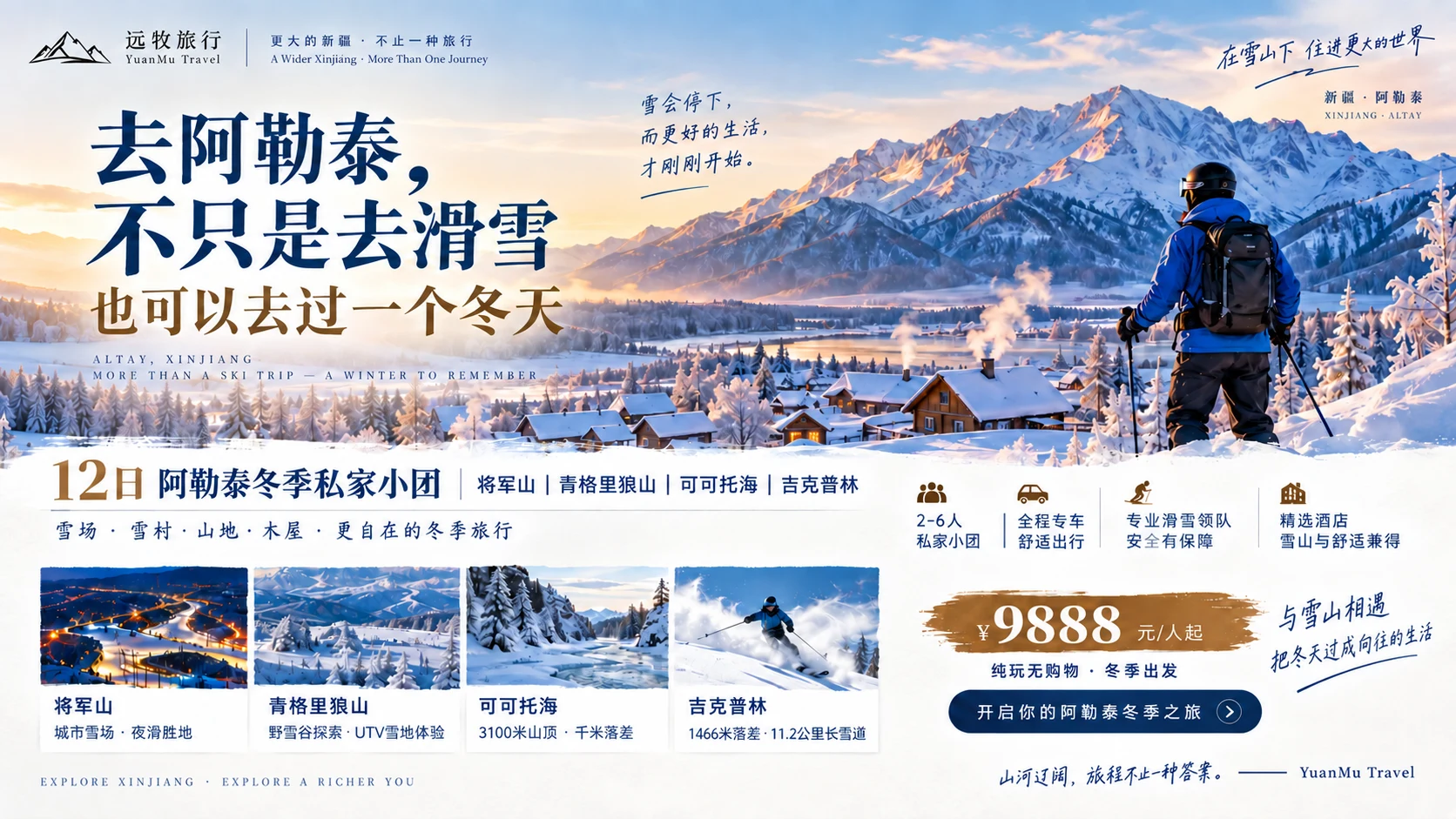
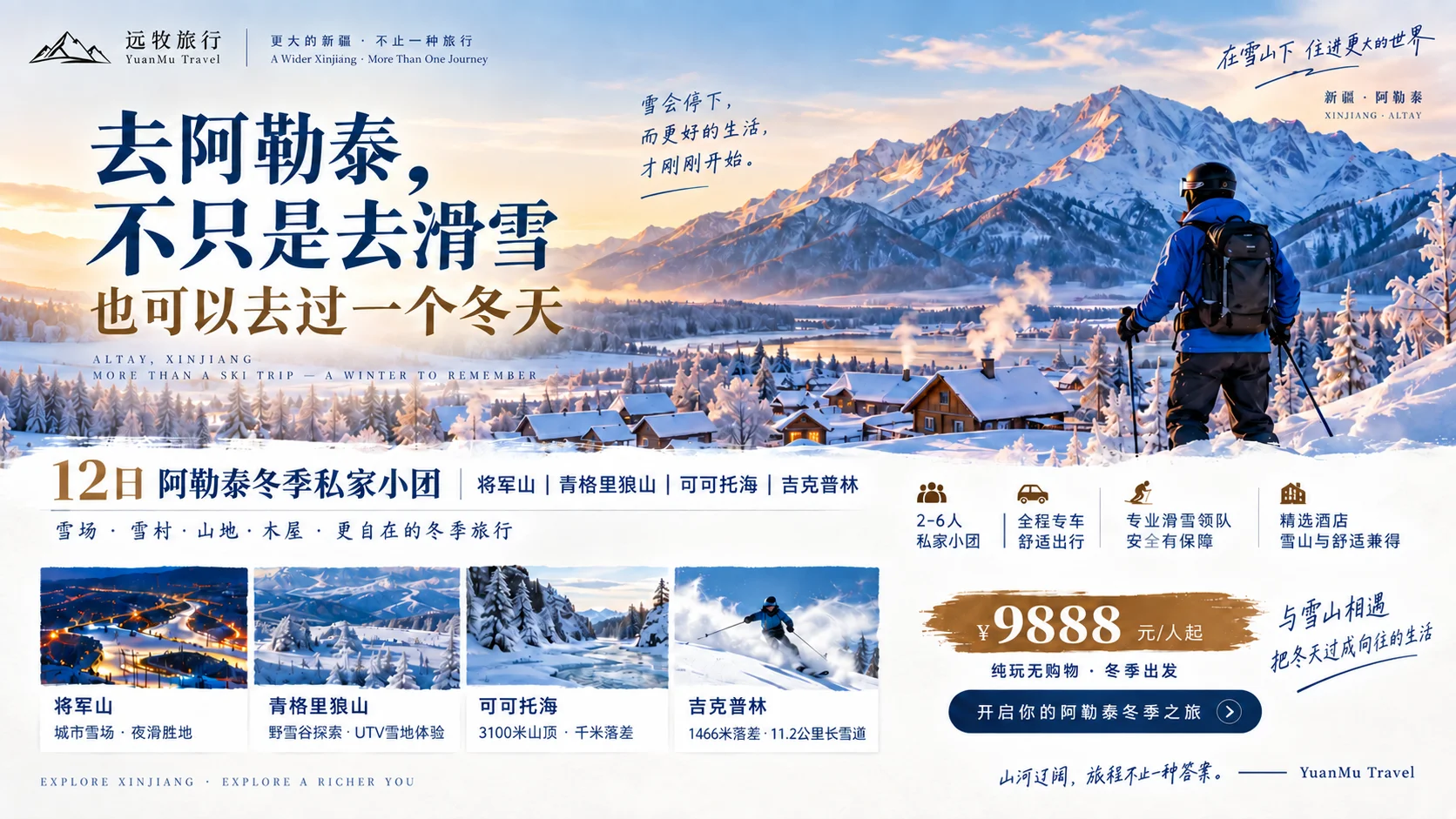
If this essay makes you want not only to understand winter in Altay, but to actually set out, the poster below turns that idea into a real itinerary. It is not the only answer suggested by this article. It is one more ski-focused version of the same winter, still leaving room for villages, cabins and the slower texture of the season.
Product note: this international edition shows a reference starting price of US$1,390 per person. It is converted from the RMB 9,888 starting price at an indicative rate of about RMB 7.12 to US$1; the final USD amount may vary with the exchange rate at the time of quotation or payment.
The land is vast. A journey has more than one answer.With every arrival, see Xinjiang anew.
Source note: This essay is about how a winter journey is organised. It does not promise specific opening dates, snow conditions, lift operations, ticket prices, roads or shuttles for the 2026–27 season. Winter conditions change quickly; always check current official notices, road conditions and weather forecasts before travel.
Begin in Altay City. Enter winter before chasing it.
On a first winter trip to Altay, there is a temptation to bring the climax forward. You land with ski trousers, gloves and goggles in your luggage. The ridges are already white. The obvious next move seems to be the biggest, farthest resort.
Altay City offers a better opening. Jiangjunshan sits close to town, tied to hotels, restaurants, equipment and transport. Xinjiang’s recent winter planning still places Jiangjunshan, Jikepulin and Koktokay at the heart of Altay’s ski landscape. But for a first-time visitor, the opening day does not need to settle which resort is “best.” It needs to settle you into winter.
Fit the gear properly. Meet the instructor. Spend enough time outside to understand the cold. See what a full day on snow does to your legs. Some people finish wanting more speed. Others realise the next day should be slower. That knowledge is worth more than squeezing in another mountain.
A good opening does not rush the climax. It lets you enter the season. In that sense, Jiangjunshan is a doorway: the city is still behind you, but Altay winter has already begun.
The journey changes language when you stay in Hemu
The trip changes on the road from Altay City to Hemu. In town, snow belongs to streets, headlights, ski lifts and the evening. In Hemu, it settles on roofs, slopes, forest edges and the empty ground between houses. You are no longer going out to “see snow.” For a while, you live inside a place rearranged by it.
Hemu is easy to compress into one image: timber houses, smoke, hills, white ground. Arrive at noon, take the picture and leave the next morning, and the village can remain a view. The second morning changes that. The first day is about finally being there. The second gives you time to notice where the light enters, when the lanes go quiet, when to walk out and when to come back in.
That is why two nights are not simply a hotel choice. They turn a sleeping point into a real stay. You can often tell what a route values by where it chooses to spend the night.
Once the night belongs to Hemu, Jikepulin no longer has to carry the whole meaning of the destination. Skiing can become the strongest chapter of the stay. The village remains the world around it.
Give Jikepulin one complete day
Jikepulin is worth a trip in its own right. If skiing is the main purpose, staying at one resort for several days — or much longer — makes perfect sense. Fewer transfers. Less luggage. More time on snow. It is a clean, focused kind of journey.
A mixed winter trip asks a different question. If not everyone is a skier, and if you also want Hemu, Kanas and the life of Altay itself, should every day repeat the same intensity?
Place Jikepulin in the middle of a two-night Hemu stay and the rhythm becomes clear. Day one enters the village. Day two belongs entirely to the mountain. Day three moves on. The ski day becomes a peak without swallowing the whole journey.
A climax needs contrast. If every day tries to be faster, higher and fuller, very little is left to remember as the high point.
Opening dates, piste access, lift operations, ticket prices, night skiing and shuttle rules for the 2026–27 season remain short-cycle information. They should be checked against current resort notices, not frozen into a promise made in September.
After the ski day, go quiet in Kanas
Sometimes a journey needs one simple move: stop repeating the thing you have just enjoyed.
Moving from Hemu and Jikepulin to Kanas can look like a move from “something to do” to “nothing to do.” Skiing has pistes, lifts, speed and a clear beginning and end. Kanas in winter is closer to subtraction. Mountain, forest, lake and river remain, but there is no need to keep completing tasks.
That is exactly why it belongs here. The first days ask the body to work: dress, climb, ski, descend. Kanas returns the journey to walking, looking, waiting for light and feeling the cold. Intensity moves from sport back to space. Winter itself becomes audible again.
Kanas is therefore not a sightseeing add-on after the skiing. In this kind of route, it is the true close: not another climax, but a place for the journey to become quiet after one.
Winter needs space. Do not fill it.
Summer in Xinjiang encourages efficiency. The days are long. The road is still open ahead. Once you have come this far, one more stop always seems possible. Winter slowly dismantles that logic.
Cold makes dressing slower. Skiing creates a real need for recovery. Mountain weather adds uncertainty to roads and shuttles. Shorter daylight changes what an afternoon can hold. Xinjiang’s 2026 winter safety analysis also highlighted peak crowds, higher-risk snow activities, lift operations and unmanaged outdoor exploration as risks requiring active control.
So half a day with no “attraction” is not necessarily empty. It may be recovery after the mountain, a buffer for weather, another afternoon in Hemu, or simply enough time to dry wet gloves and eat dinner without watching the clock.
Space is not wasted time. It is both a safety margin and the room in which winter travel becomes humane. The expensive hours in a winter itinerary are often not the ones that add places. They are the ones that remove panic.
Not everyone needs this version of Altay
Putting Jiangjunshan, Hemu, Jikepulin and Kanas into one journey does not make the journey right for everyone.
If the only goal is to maximise ski time, the better plan is usually simpler: choose the resort that suits you, choose the right accommodation and stay there. Fewer transfers. Less luggage. More energy and money spent on the thing you actually came to do. That is cleaner and more honest.
But if this is your first winter in Altay; if not everyone in the group is an experienced skier; if you want snow sports without giving up villages, forest, lake country and the life of a northern city, a mixed structure can make more sense.
Nor should it be sold automatically as “easy for seniors” or “effortless for families.” Cold, roads, walking surfaces, equipment and ski intensity all need to be judged against age, fitness and current weather. The best route is not the one that includes the most. It is the one that fits the people travelling it.
Sometimes the point is simply to live a few days of winter
Winter destinations are easy to describe with numbers: ski days, resorts, villages, centimetres of snow. The memories that last are usually less orderly.
It may be the darkness outside when you return to Altay City after the mountain. It may be the second morning in Hemu, when you no longer rush to take the first photograph. It may be standing in Kanas the day after a hard ski day and realising that quiet can carry a journey too.
Summer in Xinjiang often makes you want to keep moving. Winter can make staying feel like another form of arrival. Come back to the wooden house early. Leave the gloves by the heater. Watch the window turn blue, then dark.
In the morning, the snow is still there.
That is when Altay stops being a list of things to finish. You have not missed anything. You have simply stayed long enough to live a few real winter days in one place.
One Way to Begin the Journey
If this essay makes you want not only to understand winter in Altay, but to actually set out, the poster below turns that idea into a real itinerary. It is not the only answer suggested by this article. It is one more ski-focused version of the same winter, still leaving room for villages, cabins and the slower texture of the season.
Product note: this international edition shows a reference starting price of US$1,390 per person. It is converted from the RMB 9,888 starting price at an indicative rate of about RMB 7.12 to US$1; the final USD amount may vary with the exchange rate at the time of quotation or payment.