WeChat Rich-Text CopyClick, then paste into the WeChat editorCopy Full Article
WeChat Rich-Text CopyClick, then paste into the WeChat editor
WeChat Rich-Text Copy
Click, then paste into the WeChat editor
YUANMU · WINTER CITY / ALTAY
In Altay, the snow season never begins with the first snowfall. Winter arrives earlier — in summer construction, autumn training, road plans, airport links and the quiet work of getting a city ready.
Snow can arrive overnight.A city may spend months preparing for it.
In September, Altay has not yet become the winter people come to photograph. The mountains are not fully white. The city has not reached its busiest rhythm.
But move the calendar back and the season is already under way. In the summer of 2026, the region's ski areas were using the construction window to prepare for the next snow season. Jiangjunshan was maintaining pistes, upgrading pipelines, expanding lift capacity and improving digital systems, while also strengthening rentals, sports recovery, dining and accommodation. Supporting work at Jikepulin was moving toward completion.
Travellers see the doors open after the snow arrives. Much of the work behind those doors happens while the ground is still green.
Winter is not something that suddenly happens to Altay. Altay gradually changes into a place that can run well in winter.
On a first visit, the mountain dominates the picture: pistes, gondolas, boards, night skiing and the clean geometry of snow.
A serious winter destination, however, cannot live on a mountain alone.
A beginner needs the right instructor. A family needs more than a lift ticket. A skier needs equipment, storage and a room close enough to the hill. Someone travelling with a non-skier needs a day that still makes sense. Xinjiang's regional ice-and-snow strategy treats accommodation, equipment, training facilities, winter towns and digital management as parts of the same system.
What the traveller is really buying is not just access to snow. It is a set of conditions that allows several winter days to work.
A WINTER DESTINATION IS A SYSTEM
Runs and lifts → equipment and instructors → hotels and food → airports and rail → local transfers → road maintenance → gear storage → emergency support and insurance → time a traveller can actually use
A ski area may sit on a mountain. A ski trip begins at an airport, a railway station or a winter road.
Altay Prefecture now operates three airports — Altay Xuedu, Kanas and Koktokay — alongside rail and road links connecting the region's winter destinations. When the snow season begins, that network changes rhythm again.
During the 2025–26 season, transport authorities ran a direct link between Jiangjunshan and Koktokay, temporary airport-to-hotel services and other transfers connecting airports or railway stations with hotels and ski areas. Buses, taxis, ride-hailing fleets and emergency vehicles were adjusted around winter demand.
Road work belongs to the same story. In September 2026, transport officials reviewing the Ahe Highway were still focused on winter maintenance, extreme-weather resilience and emergency access. None of this is likely to appear in the photograph a visitor takes home. Yet it determines whether skis reach the hotel smoothly, whether a late run can still end back in town, and how much margin remains when weather turns.
A city's winter often reveals itself in the connections between places.
Long before most guests arrive, another group has already entered winter.
Ahead of the previous season, newly hired instructors at Jiangjunshan were checking skis, boots and helmets, adjusting bindings and going through induction, fire-safety and emergency training. One recruitment round added 35 employees, more than 60 per cent of them local hires.
That exposes a different scale of winter travel: a visitor's few days can be somebody else's entire working season.
Instructors return. Rental shops check inventory. Hotels rebuild rosters. Drivers re-learn winter roads. Restaurants change their hours. One person comes to Altay to make a first turn on snow; another finds a first job built around it.
Preparing for winter also means rearranging people's time.
A first-time skier, someone who wants six hard hours on snow, a family with children and a traveller who simply wants to spend a few slow days inside a northern winter may all use the same city very differently.
The better question is not how many resorts can fit into an itinerary.
What kind of winter does this traveller actually want to live?
Perhaps a destination becomes mature not when everybody does the same thing, but when it learns how to receive different people well.
Different travellers, different winters. Skiing is only the beginning; a complete winter also includes the city, food, local life and time beyond the slopes.
Once the season is running, much of the preparation becomes invisible again.
The lift starts on time. The equipment is ready. Someone meets the flight. The hotel room is warm. A road covered overnight has been cleared before breakfast. When everything works, we rarely notice that any of it had to be prepared.
Winter then seems to have fallen from the sky.
Look away from the mountain for a moment and another winter appears. It begins in summer construction, autumn training, an equipment check, a road-maintenance plan, a hotel roster and the route of a shuttle bus.
Snow may need one night.A city may need months to be ready for it.
YUANMU · TRAVEL INTERPRETATION
We do not only want to tell travellers what winter offers.
We want to explain how a place enters winter — and why a journey should change with it.
Vast landscapes. More than one way to travel.Every arrival is a chance to understand Xinjiang again.
Source note: This story looks at the city and regional systems that prepare Altay for the snow season. Transport, resort operations, flights, opening dates, pistes, prices and individual services change with the year, weather and operating policy. For the 2026–27 season, follow current official announcements and real-time conditions.
Winter begins when there is no snow
In September, Altay has not yet become the winter people come to photograph. The mountains are not fully white. The city has not reached its busiest rhythm.
But move the calendar back and the season is already under way. In the summer of 2026, the region's ski areas were using the construction window to prepare for the next snow season. Jiangjunshan was maintaining pistes, upgrading pipelines, expanding lift capacity and improving digital systems, while also strengthening rentals, sports recovery, dining and accommodation. Supporting work at Jikepulin was moving toward completion.
Travellers see the doors open after the snow arrives. Much of the work behind those doors happens while the ground is still green.
Winter is not something that suddenly happens to Altay. Altay gradually changes into a place that can run well in winter.
The ski resort is only the most visible part
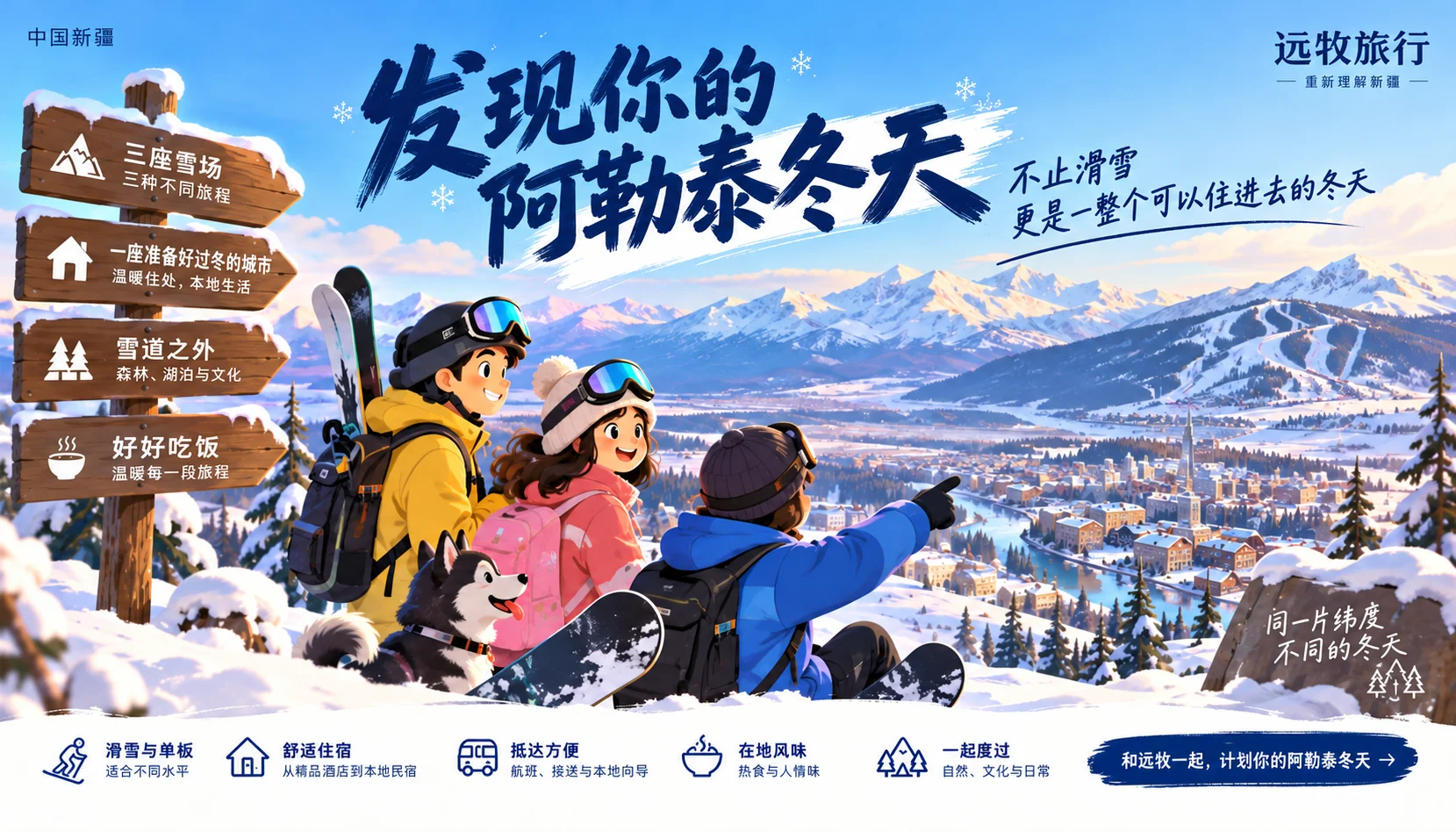
On a first visit, the mountain dominates the picture: pistes, gondolas, boards, night skiing and the clean geometry of snow.
A serious winter destination, however, cannot live on a mountain alone.
A beginner needs the right instructor. A family needs more than a lift ticket. A skier needs equipment, storage and a room close enough to the hill. Someone travelling with a non-skier needs a day that still makes sense. Xinjiang's regional ice-and-snow strategy treats accommodation, equipment, training facilities, winter towns and digital management as parts of the same system.
What the traveller is really buying is not just access to snow. It is a set of conditions that allows several winter days to work.
Before skiing, a winter city has to solve arrival
A ski area may sit on a mountain. A ski trip begins at an airport, a railway station or a winter road.
Altay Prefecture now operates three airports — Altay Xuedu, Kanas and Koktokay — alongside rail and road links connecting the region's winter destinations. When the snow season begins, that network changes rhythm again.
During the 2025–26 season, transport authorities ran a direct link between Jiangjunshan and Koktokay, temporary airport-to-hotel services and other transfers connecting airports or railway stations with hotels and ski areas. Buses, taxis, ride-hailing fleets and emergency vehicles were adjusted around winter demand.
Road work belongs to the same story. In September 2026, transport officials reviewing the Ahe Highway were still focused on winter maintenance, extreme-weather resilience and emergency access. None of this is likely to appear in the photograph a visitor takes home. Yet it determines whether skis reach the hotel smoothly, whether a late run can still end back in town, and how much margin remains when weather turns.
A city's winter often reveals itself in the connections between places.
A visitor stays for days. Someone else works the whole season.
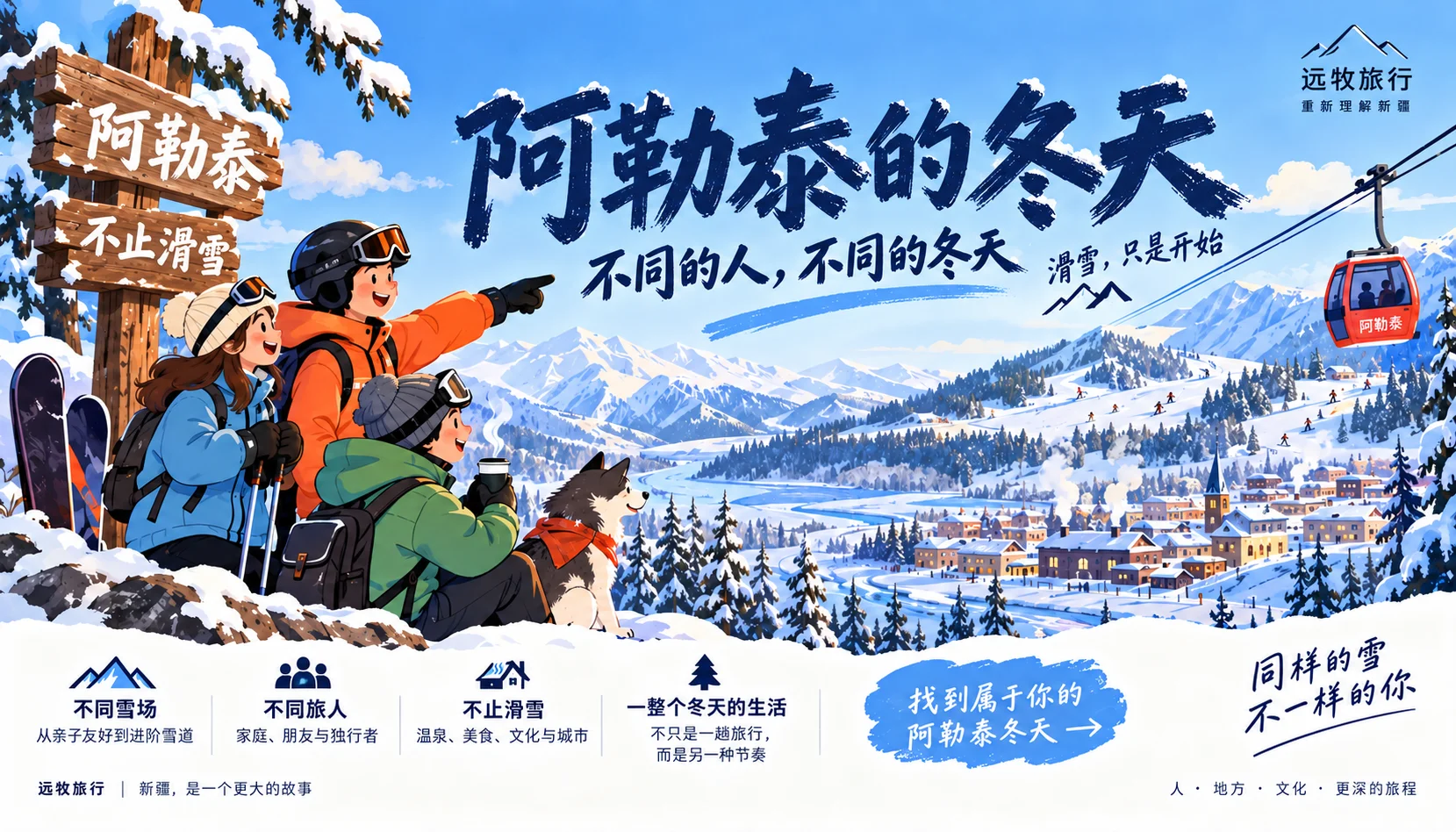
Long before most guests arrive, another group has already entered winter.
Ahead of the previous season, newly hired instructors at Jiangjunshan were checking skis, boots and helmets, adjusting bindings and going through induction, fire-safety and emergency training. One recruitment round added 35 employees, more than 60 per cent of them local hires.
That exposes a different scale of winter travel: a visitor's few days can be somebody else's entire working season.
Instructors return. Rental shops check inventory. Hotels rebuild rosters. Drivers re-learn winter roads. Restaurants change their hours. One person comes to Altay to make a first turn on snow; another finds a first job built around it.
Preparing for winter also means rearranging people's time.
A mature winter destination does not ask everyone to live the same winter
A first-time skier, someone who wants six hard hours on snow, a family with children and a traveller who simply wants to spend a few slow days inside a northern winter may all use the same city very differently.
That is also why YuanMu has separated its winter planning by traveller rather than by resort list. Beginners need instruction, equipment, short transfers and recovery. Serious skiers care about usable snow time and efficient movement between mountains. Families need to design the hours when children are not skiing. Premium trips depend on continuity — rooms, transfers and service details working as one. Off-piste experiences only make sense in legal terrain, with professional guidance and conditions that are safe on the day.
The better question is not how many resorts can fit into an itinerary.
What kind of winter does this traveller actually want to live?
Perhaps a destination becomes mature not when everybody does the same thing, but when it learns how to receive different people well.
By the time the first snow falls, the hard work has disappeared
Once the season is running, much of the preparation becomes invisible again.
The lift starts on time. The equipment is ready. Someone meets the flight. The hotel room is warm. A road covered overnight has been cleared before breakfast. When everything works, we rarely notice that any of it had to be prepared.
Winter then seems to have fallen from the sky.
Look away from the mountain for a moment and another winter appears. It begins in summer construction, autumn training, an equipment check, a road-maintenance plan, a hotel roster and the route of a shuttle bus.
Snow may need one night.A city may need months to be ready for it.