
WeChat Rich-Text CopyCopy article only — stable inline formattingCopy Full Article
WeChat Rich-Text CopyCopy article only — stable inline formatting
WeChat Rich-Text Copy
Copy article only — stable inline formatting
YUANMU · 2026 AUTUMN / SOUTHERN XINJIANG
Autumn does not arrive everywhere in Southern Xinjiang at once. This year, the route should follow the leaves.
Every autumn, one question returns: when is the best time to see Xinjiang's poplar forests?
It sounds like a question about a date. Once you begin building the route, it becomes a different question: where has autumn arrived now?
The 2026 seasonal outlook makes that especially relevant. The better viewing period is expected to arrive slightly later than in 2025. Aksu and Bayingolin are forecast to turn earlier, while Kashgar and Hotan should follow later. Across Southern Xinjiang, the stronger window is expected from the latter part of October into early November.
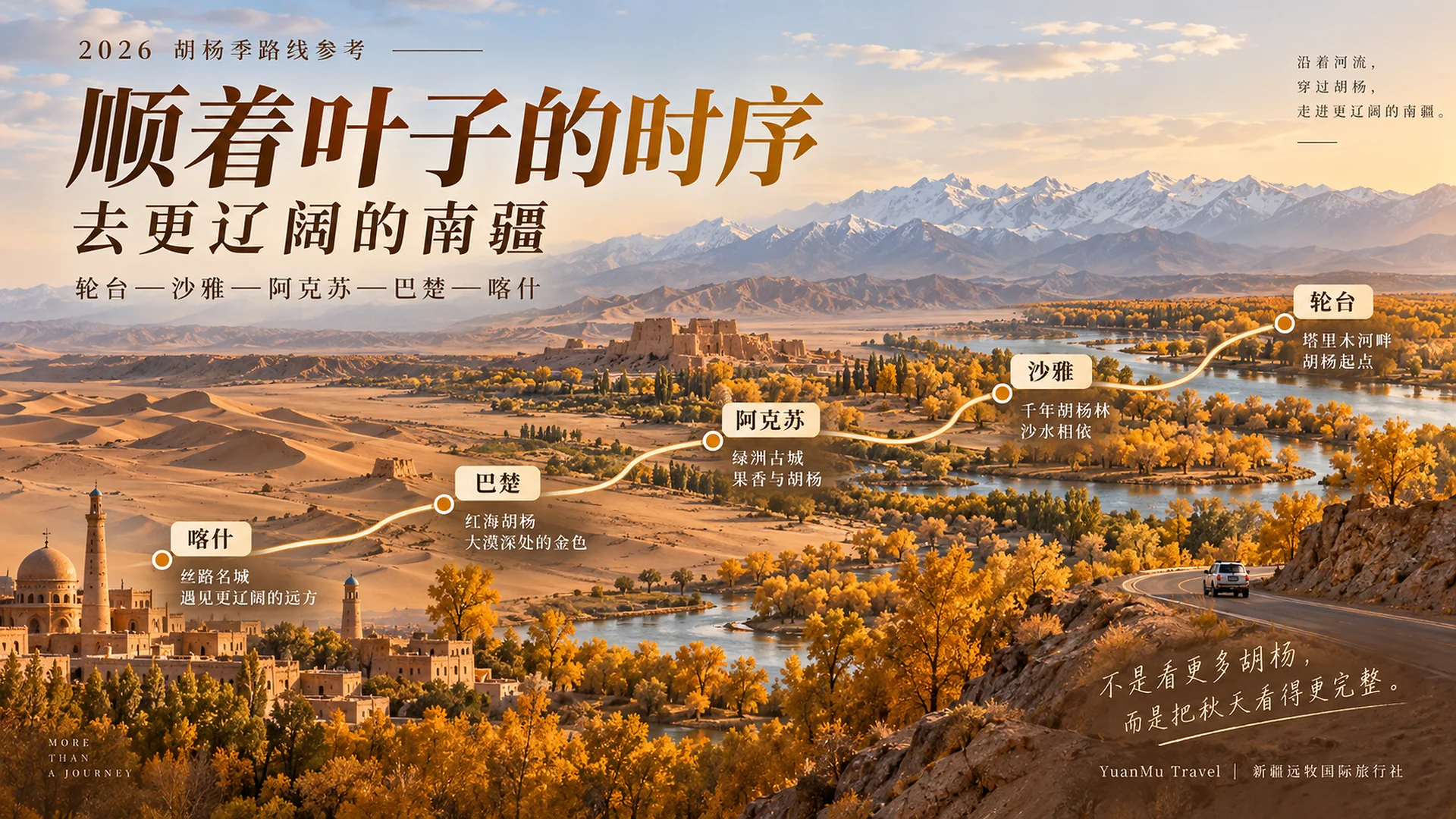
2026 Southern Xinjiang poplar-season campaign visual.
01 · FOLLOW THE LEAVES
A classic Southern Xinjiang itinerary often starts with a complete-looking loop: Kashgar, Bachu, Aksu, Kuqa, Luntai, Shaya, Hotan, then back again. The map may look tidy. The trees do not care.
If Luntai and Shaya are already entering their better colour while Zepu and Bachu are still behind, a rigid route simply carries the traveller away from the autumn that is ready and toward the autumn that is not.
The better order is simple:departure date → leaf timing → route.
02 · ONE CLIMAX A DAY
Luntai, Shaya, Zepu and Bachu all have poplar landscapes. That makes one mistake very easy: if they are all on the way, put them all in.
But a poplar forest is not a fifteen-minute stop. It needs light, walking, patience, and time to simply remain in one place. Once a day already carries four or five hours of driving, adding two full forest experiences often means neither is seen well.
Being on the way only solves the map.A mature route still has to decide where the day truly belongs.
03 · NOT ALL POPLARS ARE THE SAME
The useful question is not which forest is bigger. It is what role each place plays in the journey.
Luntai: the strongest candidate for the route's main anchor — Tarim River forests, Silk Road history, road culture and an overnight stay that gives the place real time.
Shaya: better as a water-and-road chapter. Its difference is the way waterways enter the poplar landscape, not another repeat of a golden forest.
Zepu: more convincing when paired with Shache, oasis life, night markets and a slower urban stop.
Bachu: wetlands, river, villages and local life can turn the poplars into a full destination chapter, not a quick stop on the way back.
Route campaign visual | Follow the order of the leaves into a wider Southern Xinjiang.
04 · STAY WHERE AUTUMN IS
Luntai is no longer just a forest ticket. The Tarim poplar landscape, regional history, road travel, hotels and local food can now be understood as one destination system. Staying a night is not about luxury. It gives the place enough time to become a chapter rather than a stop.
Bachu deserves the same treatment. Its Red Sea scenic area combines a long internal loop with poplars, wetlands, river landscapes, old routes and village life. If it is the day's anchor, it needs more than a quick photograph between two cities.
A place becomes part of the journey when it is allowed to have an evening.
05 · LESS, BUT BETTER
If collecting four poplar areas means spending the best morning and evening light on the road, we would rather remove one.
Keep the time for a real sunset, a quiet morning, a dinner that does not need to be rushed, or one night when the bags do not have to move again.
The most expensive thing in a journey is rarely the ticket.It is the part of the day that truly belongs to one place.
Perhaps the best way to travel Southern Xinjiang's poplar season in 2026 is not to see more gold, but to let the route move with autumn — and be there when the colour is finally right.
Vast landscapes. More than one way to travel.See Xinjiang anew with every arrival.
Note: The 2026 viewing periods discussed here are seasonal forecasts, not a guarantee of leaf colour on a specific departure date. Colour, weather, site operations, road conditions and hotel availability should be checked again close to departure.
Do not draw the route too early
A classic Southern Xinjiang itinerary often starts with a complete-looking loop: Kashgar, Bachu, Aksu, Kuqa, Luntai, Shaya, Hotan, then back again. The map may look tidy. The trees do not care.
If Luntai and Shaya are already entering their better colour while Zepu and Bachu are still behind, a rigid route simply carries the traveller away from the autumn that is ready and toward the autumn that is not.
The better order is simple:departure date → leaf timing → route.
Give each day one real poplar climax

Luntai, Shaya, Zepu and Bachu all have poplar landscapes. That makes one mistake very easy: if they are all on the way, put them all in.
But a poplar forest is not a fifteen-minute stop. It needs light, walking, patience, and time to simply remain in one place. Once a day already carries four or five hours of driving, adding two full forest experiences often means neither is seen well.
Being on the way only solves the map.A mature route still has to decide where the day truly belongs.
Four poplar areas do not need four equal stars
The useful question is not which forest is bigger. It is what role each place plays in the journey.
Luntai: the strongest candidate for the route's main anchor — Tarim River forests, Silk Road history, road culture and an overnight stay that gives the place real time.
Shaya: better as a water-and-road chapter. Its difference is the way waterways enter the poplar landscape, not another repeat of a golden forest.
Zepu: more convincing when paired with Shache, oasis life, night markets and a slower urban stop.
Bachu: wetlands, river, villages and local life can turn the poplars into a full destination chapter, not a quick stop on the way back.
Why Luntai and Bachu deserve an overnight stay
Luntai is no longer just a forest ticket. The Tarim poplar landscape, regional history, road travel, hotels and local food can now be understood as one destination system. Staying a night is not about luxury. It gives the place enough time to become a chapter rather than a stop.
Bachu deserves the same treatment. Its Red Sea scenic area combines a long internal loop with poplars, wetlands, river landscapes, old routes and village life. If it is the day's anchor, it needs more than a quick photograph between two cities.
A place becomes part of the journey when it is allowed to have an evening.
This year, we would rather see one forest less
If collecting four poplar areas means spending the best morning and evening light on the road, we would rather remove one.
Keep the time for a real sunset, a quiet morning, a dinner that does not need to be rushed, or one night when the bags do not have to move again.
The most expensive thing in a journey is rarely the ticket.It is the part of the day that truly belongs to one place.
Perhaps the best way to travel Southern Xinjiang's poplar season in 2026 is not to see more gold, but to let the route move with autumn — and be there when the colour is finally right.