
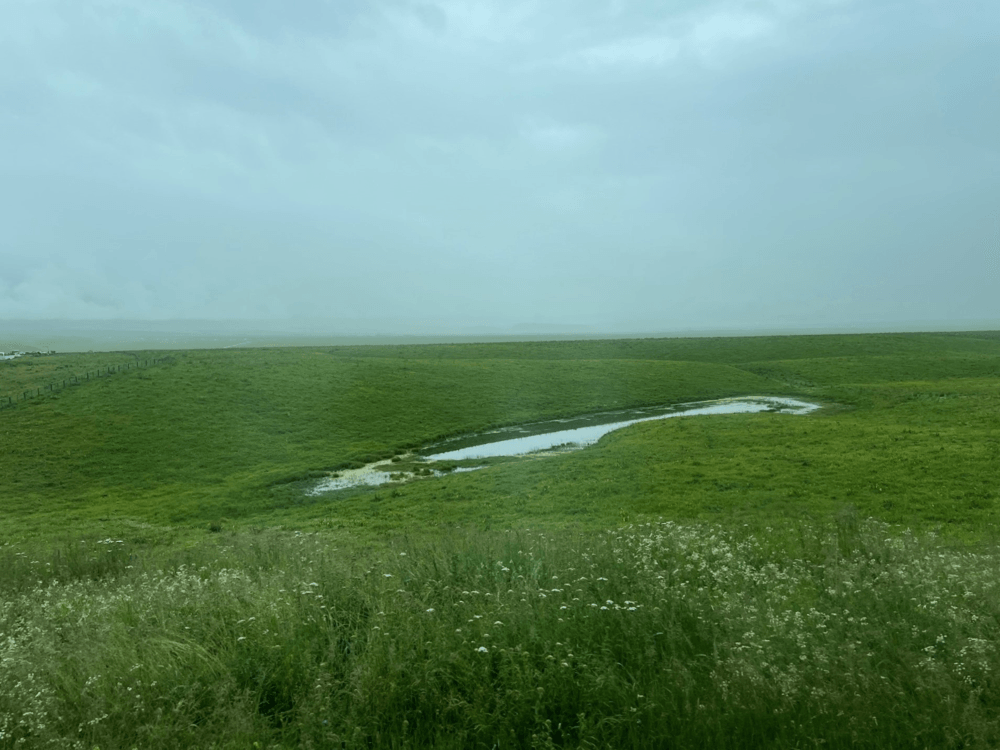
The Grasslands of Xinjiang Where the Land Becomes Pasture
From Nalati and Kalajun to Zhaosu, Tangbula and Bayan Bulag, follow the slopes, pastures, village roads, river valleys and wetlands that make Xinjiang's grasslands lived-in landscapes rather than empty scenery.
Xinjiang’s grasslands—from Nalati and Kalajun to Zhaosu, Tangbula and Bayan Bulak—are lived pasture geography shaped by slope, water and season, not empty scenic checklist country.
The grassland looks empty. It is anything but.
At first, Xinjiang's grasslands can feel almost extravagantly open. The horizon pulls away. The sky seems larger than it should. Cattle and sheep shrink to moving marks in the distance. In a landscape this spacious, it is easy to lose track of time — and just as easy to mistake what you are seeing for scenery alone.
Stay a little longer and the frame fills in. There are paths worn into the slopes by livestock, grass flattened beside water, houses and fences near the forest line. In the morning, cattle move from one grazing ground to another. Toward evening, horses come back down the dirt tracks. Wind lays the grass in one direction; colder weather sends people and animals toward another place to stay.
That is when the word grassland begins to feel incomplete. In Xinjiang, many of these open landscapes are also pastures — spaces shaped by altitude, water, season and long use. The places may share a name on a map, yet feel entirely different underfoot.
First, read the slope
Grasslands are often described as open country. In Xinjiang, they are rarely flat. Height, angle and ridge lines decide where grass grows, where animals pass, and how a journey moves through the land.
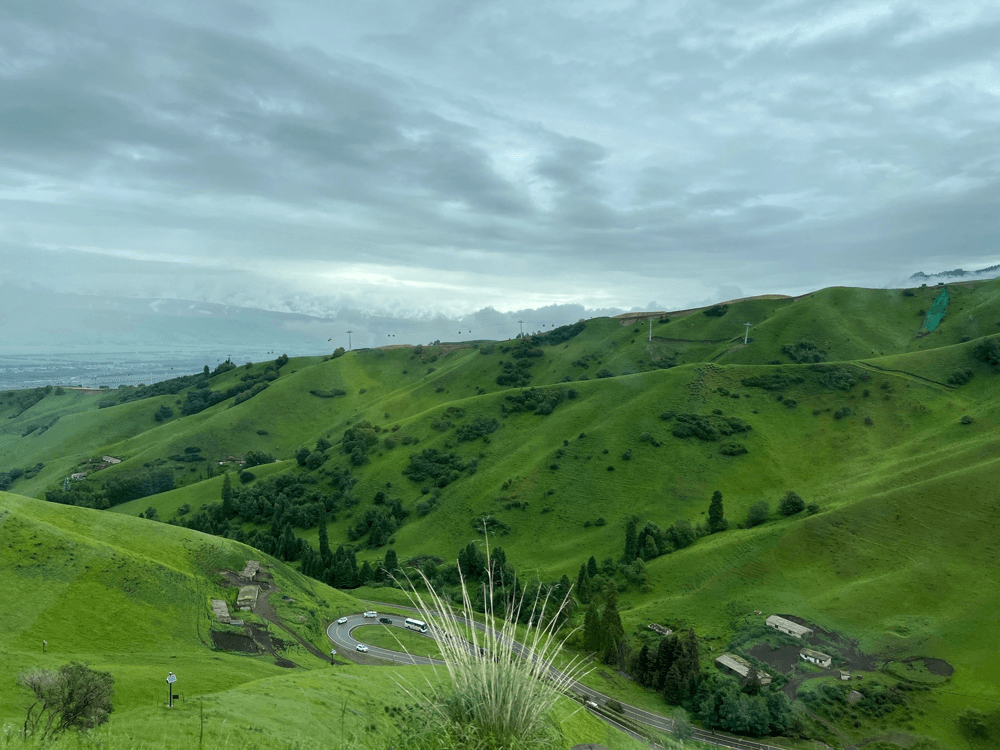
Nalati | The grass begins to climb
In Nalati, the first thing to change is not the colour but the height. Grass lifts out of the valley floor and runs uphill; forest settles into deeper folds and gullies. Round a bend and one grazing slope drops away, only for another green plane to appear beyond it.
It is terrain that plays tricks with distance. A hillside that looks gentle from across the valley can take far longer to cross than expected. Cattle and sheep become small. A yurt may register as no more than a pale mark on the slope. Rather than diminishing the landscape, these details give it scale.
Nalati is often at its best when the light is unsettled. Clouds come through a mountain gap; a slope brightens, then darkens; the green deepens before your eyes. In those shifts, the grassland stops behaving like a backdrop. It becomes what it has always been: mountain country shaped by altitude, weather and grazing.
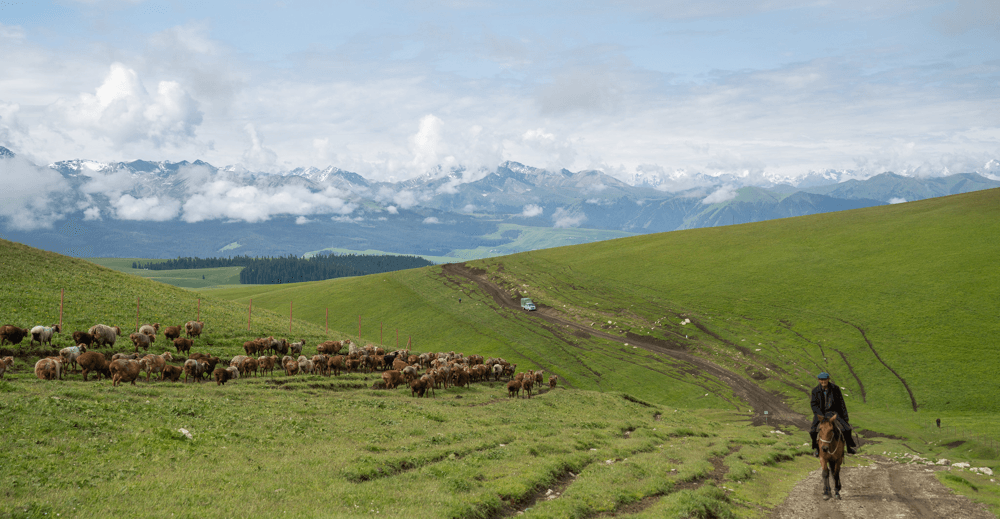
Kalajun | When the land finds its lines
At Kalajun, the contours sharpen. Ridges look almost drawn in. Slopes lean in different directions and cloud shadows drift over them at walking pace. In good light, the grass breaks into clear bands of brightness and shade, and for a moment the land itself seems composed.
What makes Kalajun more than a beautiful view, though, are the marks of use. A rider follows the crest. Sheep gather where the ground eases. Mud tracks skirt the steepest pitches and take the long way around. From a distance these lines seem natural; close up, many of them belong to daily life.
If time allows, Kalajun rewards a slower day. Not because there are more viewpoints to collect, but because the hillside keeps changing without moving: light crossing a ridge, livestock choosing flatter ground, rain passing and leaving the entire mountain a different shade.
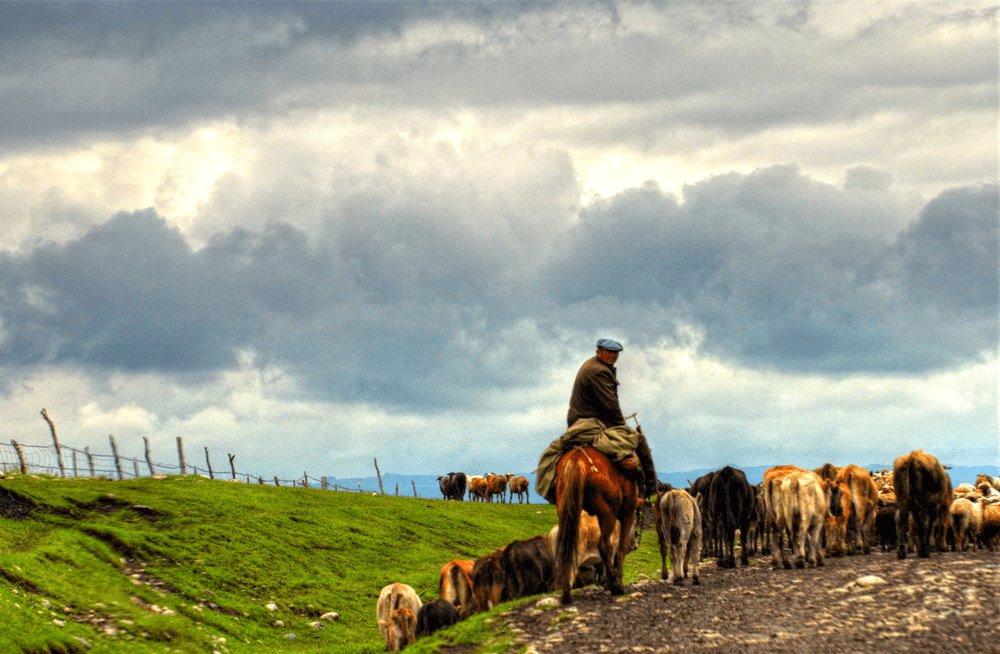
Aketasi | The pasture comes closer
Aketasi does not need to compete with Kalajun for scale. It works better at close range. Horses, cattle, dirt tracks and low fences enter the frame; the grassland is no longer something on the far side of the valley. It begins to acquire texture.
A working pasture is untidy when you stand inside it. Grass grows at different heights. Hoofprints hold water in the mud. Repeated passage exposes the earth beneath the green. These are details that standard landscape photographs tend to edit out, yet they are often the first signs that a journey has moved from viewing the land to actually being in it.
At this distance, grassland stops being a geographic label and becomes lived space. Beauty and use are not opposites here. The hoof marks, tracks and moving animals are exactly what make the place feel real.
From here on, the grassland is no longer just terrain.
Roads, villages and livestock appear more often. Whether a place deserves time is no longer decided by how spectacular it looks, but by whether you stay long enough to notice how life moves across it.
Then, look for life
The most revealing parts of a grassland journey often lie beyond the formal sights: pasture beside the highway, slopes behind a village, cattle returning at dusk, a road built for people who live here rather than people passing through.
Zhaosu | A whole landscape at work
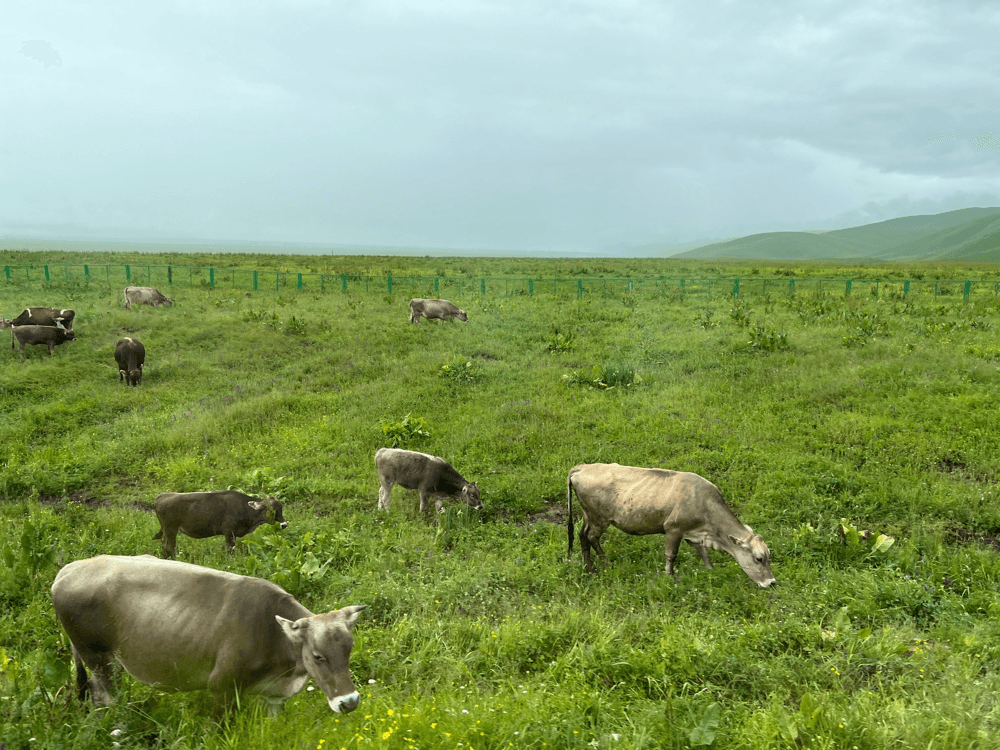
Zhaosu is difficult to understand from a single viewpoint. The most telling scenes are usually between places: pasture beside the road, cattle outside a village, mountains lowered by weather, a small track cutting across the fields.
The country feels huge, but not empty. Cattle feed their way forward. Fences divide one use of the land from another. Road verges carry the hard-packed traces of vehicles. After rain the air gains weight and the green turns darker. The longer you watch from the road, the less important the idea of a “sight” becomes.
Zhaosu is a place to give time rather than activities. Morning and evening are especially generous: livestock move, the light softens, distant mountains emerge by degrees. Those unnamed intervals can feel more characteristic of Zhaosu than any fixed camera position.
Tangbula | The valley enters the pasture
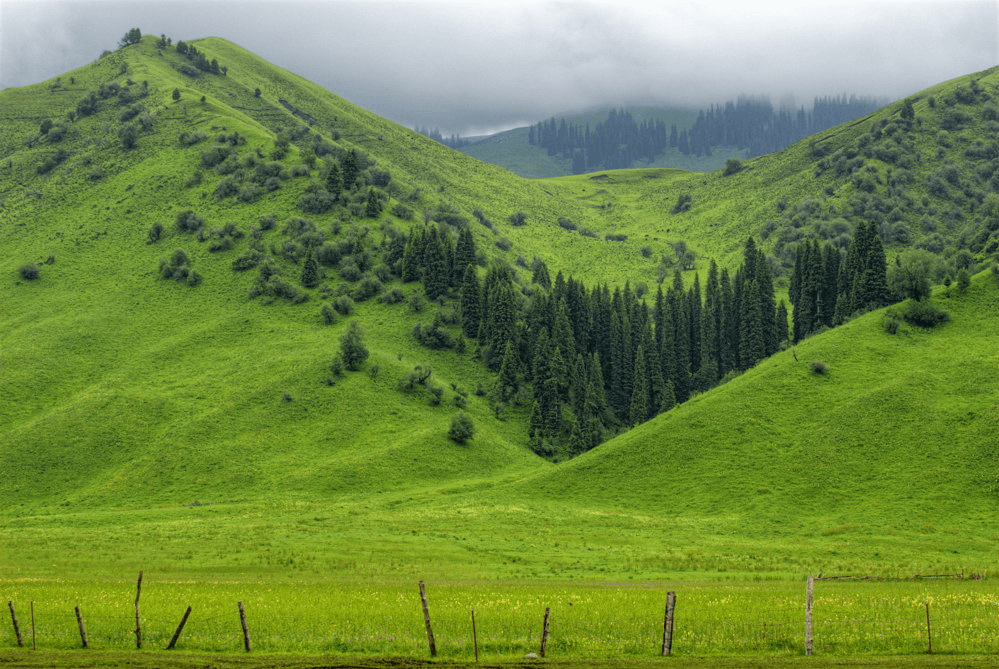
Tangbula feels different from the grasslands before it. The mountains draw closer. Forest climbs the gullies. Grazing ground no longer spreads in one unbroken sheet, but is divided by slope and tree line into smaller spaces. Your eye stops travelling only outward and begins to follow the valley inward.
That sense of narrowing suits a road journey. The road turns below the mountain. Cloud hangs behind the trees. Bright green slips into darker tones. There is often no need to hunt for a “best” position; stopping at the roadside long enough to watch the wind come down the valley can be enough.
Tangbula makes one point clearly: grassland does not have to mean exposure. Trees can enter the pasture. Rivers can give it direction. The landscape becomes more complicated — not a single green surface, but an ongoing negotiation between mountain, forest and water.
Qiongkushitai | The landscape acquires an address
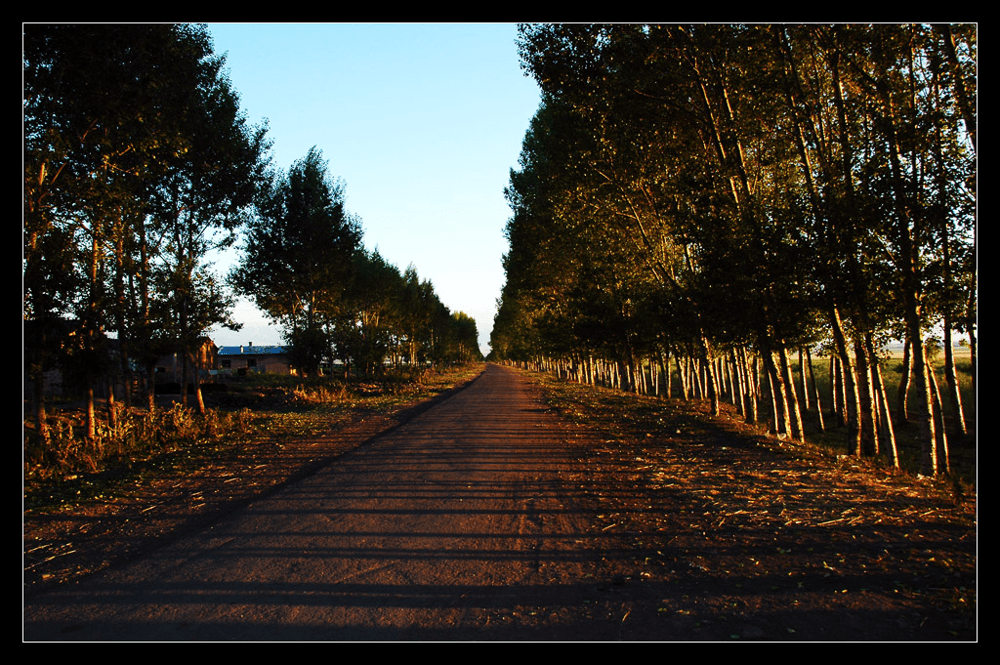
Before Qiongkushitai, the grassland mostly belongs to the distance. Enter the village and the proportions change. Trees stand closer. The road narrows. Houses, yards and slopes begin to occupy the same frame. The scenery is no longer simply “out there”; people live inside it.
What lasts here is the fact that everyday life and landform have not been pulled apart. A village road runs between trees; grass climbs again just behind the houses. Toward evening, light slips through the branches, the road darkens and the mountains beyond become unexpectedly clear. You slow down because there is suddenly more to see nearby than on the horizon.
If a grassland journey is always tempting you toward something bigger, Qiongkushitai offers another scale. A bend in the road, a line of trees, one wooden house: small things make the vastness legible again. The landscape, finally, has an address.
Finally, find the edges
Water, foothills and place names divide the grassland again. Here, green is no longer the main event. A place is defined by its relationship with wetlands, roads, higher ground and the simple fact of arrival.

Bayan Bulag | Water redraws the grassland
Bayan Bulag is where it becomes obvious that water can determine the shape of a grassland. Rivers turn slowly across the flat ground. Wetlands separate one grazing area from another. Mountains retreat into the background. Your eye follows the water, and the open space gains a direction.
The winding channels are easy to remember, but stay longer and water stops being merely scenic. It decides which ground stays wet, where grass grows thickest, and how animals can use the land. Near evening, low light catches the water while the grass darkens around it.
In our story about Xinjiang's lakes, water often brought a journey to a halt. At Bayan Bulag, it keeps moving. It does not form an endpoint; it bends and bends again across the pasture. The openness here is therefore not static. The whole surface seems to be travelling, slowly, with the river.
Jiangbulake | Sometimes a place begins with its name
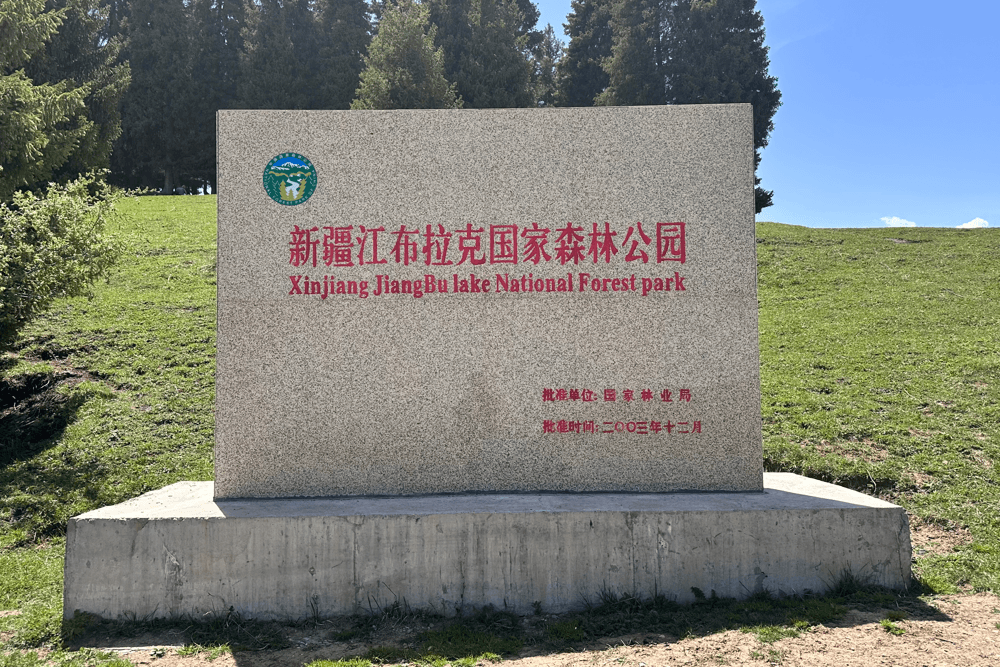
Travel does not always begin with the best view. Sometimes the first thing you meet is a sign: confirmation that you have arrived. Jiangbulake can be read that way. The name comes first; forest, slope and mountain country assemble themselves around it as the road continues.
There is something honest in that kind of arrival. A brochure would hand over the finest scene immediately. Real journeys are slower. Trees thicken. The land lifts. An opening appears without warning. Your relationship with a place often begins through these ordinary transitions rather than one dramatic reveal.
Jiangbulake is a useful reminder that memory does not depend on spectacle. A name, a road, a landscape that gradually explains itself — sometimes knowing where you are is already the first step toward understanding what you see.
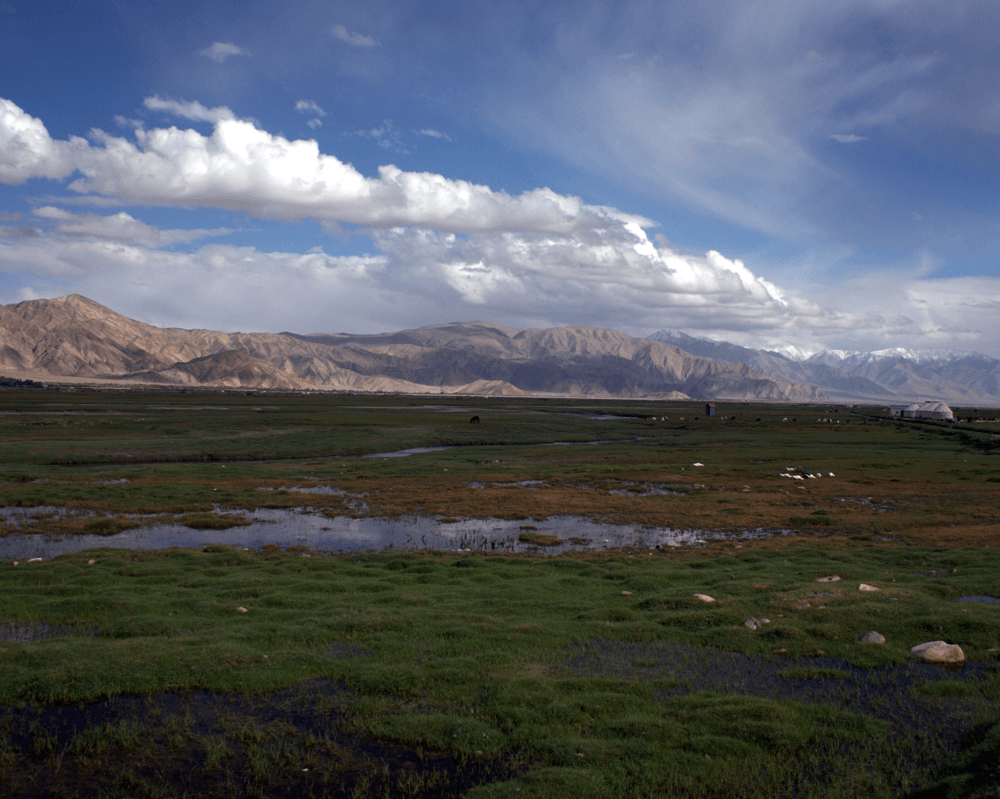
Lujiaowan | The grassland gathers itself at the foot of the mountains
At Lujiaowan, the openness changes again. Mountains stand closer. Low grassland and wetter ground spread in front of them. The sky remains large, but the country no longer feels completely unbounded. The landscape begins to show an edge.
This is a place that suits quiet observation. The mountain colours are harder. The grass is more restrained. Moisture sits close to the ground. Nothing is in a hurry to become the main subject; the power comes from the way these elements draw near to one another and make the space feel heavier.
If the earlier grasslands teach the eye to travel outward, Lujiaowan turns attention back to the foreground: wet ground, stones, shadow at the mountain foot. Here, grassland stops meaning “without end” and begins to reveal where it meets something else.
What stays with you is rarely the greenest field
After several grasslands, the urge to compare colour begins to fade. Which one is greener, which one is larger — these questions lose their hold. What remains is spatial memory: the slope of Nalati, the lines of Kalajun, the slow passage of cattle in Zhaosu, the shade that arrives when forest closes in at Tangbula, a road with an address at Qiongkushitai, the surface of Bayan Bulag repeatedly rewritten by water.
Xinjiang's grasslands are worth entering more than once precisely because they are never a single kind of landscape. Sometimes the grassland is high pasture; sometimes a village road; sometimes a river; sometimes a quiet patch of wet ground below a mountain. People move through these spaces. Livestock move too. The seasons move more slowly.
So the true scale of a grassland may never be measured by area alone. It is closer to a changing radius of life: where people can stay, where animals must pass, when to move higher, when to return lower. Once you begin to notice those patterns, the grassland steps out of the background and becomes the journey itself.