
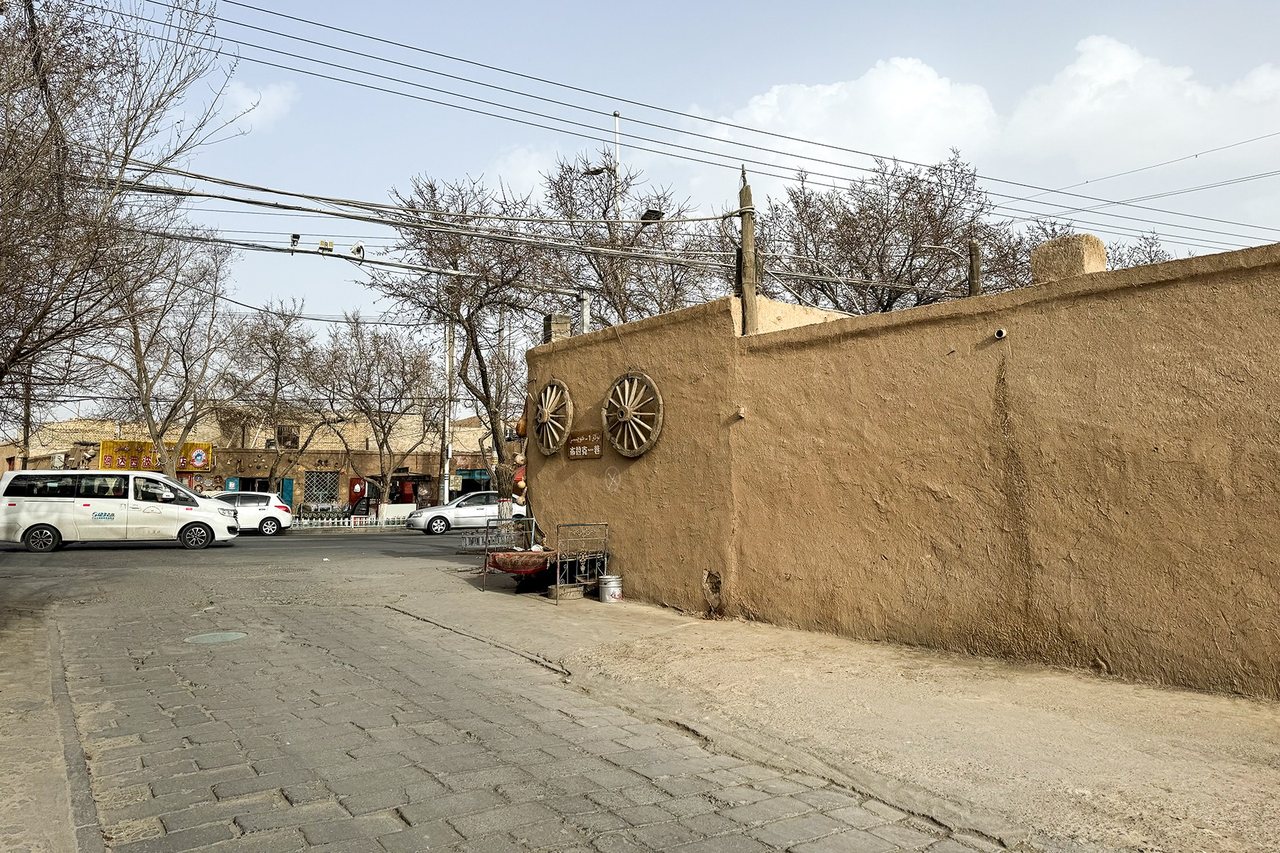
Some cities keep their history far outside town. In Kuqa, history lies just behind the highway, a lane, or an old earthen wall, layering ancient centuries directly beneath everyday life.
From ancient tombs beneath Youyi Road to the end of the Duku Highway and Subashi ruins, walking one more layer of time in Kuqa.
Another City Beneath the Street
The tombs beneath Youyi Road were discovered during urban construction in 2007.
Later archaeological work showed that this was not simply an isolated burial ground. People had used and reused this piece of land across different periods, leaving behind tombs, wells, hearths, objects and fragments of everyday life.
But when you actually stand beside the underground chambers, the dates and numbers begin to matter less.
What stays with you is something much simpler:
they were here all along.
These are not objects transported from somewhere else and placed inside a gallery.
The tombs remain in the ground where they were found.
Modern Kuqa simply continued above them.
In a conventional museum, we usually meet the object first: a pot, a coin, a fragment behind glass. A label then tells us where it came from and how old it is.
Here, the order is reversed.
You enter the place before you encounter the objects.
The direction of a wall, the distance between two chambers, the street somewhere overhead, even the changing light as you descend—all of these become part of the experience.
The architecture and objects found here also point far beyond the tombs themselves.
People moved. Objects moved.
And with them travelled techniques, customs and ideas.
Archaeology in Kuqa therefore does more than ask what happened in the past.
It raises another question:
How much time lies beneath the streets we walk today, unseen?
Back in the Sunlight, the City Carries On
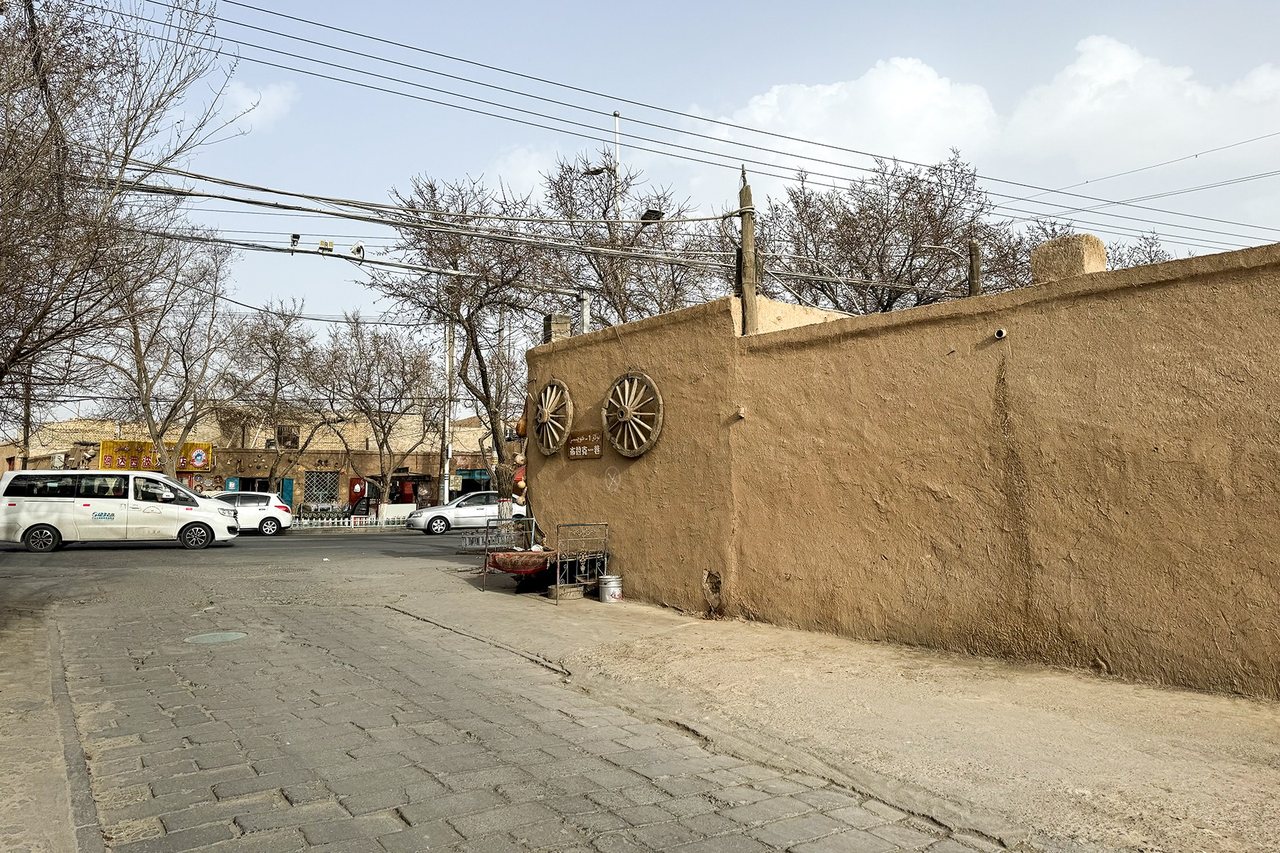
When you return to street level, the sunlight arrives all at once.
Cars are still moving along Youyi Road.
The tombs you have just seen have not somehow become distant simply because you have left the museum.
They are still beneath the same street.
That may be one of the most unusual things about Kuqa.
The distance between history and everyday life is remarkably small.
Nearby, the Qiuci Museum tells the story in another way.
The underground tombs offer a section through time: a chamber, a layer of earth, the trace of an individual life.
The museum places those fragments inside a much longer history, leading from modern Kuqa back towards Kucha, a major oasis centre in this part of the northern Tarim Basin.
The Chinese form of the historical name, 龟兹, is romanised in Hanyu Pinyin as Qiuci, which is why the museum carries that spelling. For historical Kucha itself, however, the more familiar international name remains Kucha.
The names make more sense once the geography becomes clear.
Along the southern foothills of the Tian Shan, water made oasis settlements possible. Roads linked one place of water and rest to another. People travelled between them, carrying goods, languages, skills and ways of living.
Kucha was never an isolated city.
It existed because it was connected.
But a museum can only take that idea so far.
To understand the other half of Kuqa, you need to step back outside.
History Is Not Only Behind Glass
Walk towards the old neighbourhoods and time changes form.
There are no excavated burial chambers here.
Instead there are lanes, courtyards, wooden doors, colonnades and houses that have been used again and again.
Some have been restored.
Some have new purposes.
Some remain homes.
Restaurants, small shops and cultural spaces have entered parts of the old city, and more travellers now wander through its lanes.
But the most interesting question is not which doorway makes the best photograph.
It is how different kinds of life continue to occupy the same street.
A family may still live in one courtyard while a neighbouring house has found a new use. Visitors pass through a lane that remains part of somebody else's ordinary day.
The museum asks what has been preserved.
The old city asks something different:
what is still continuing?
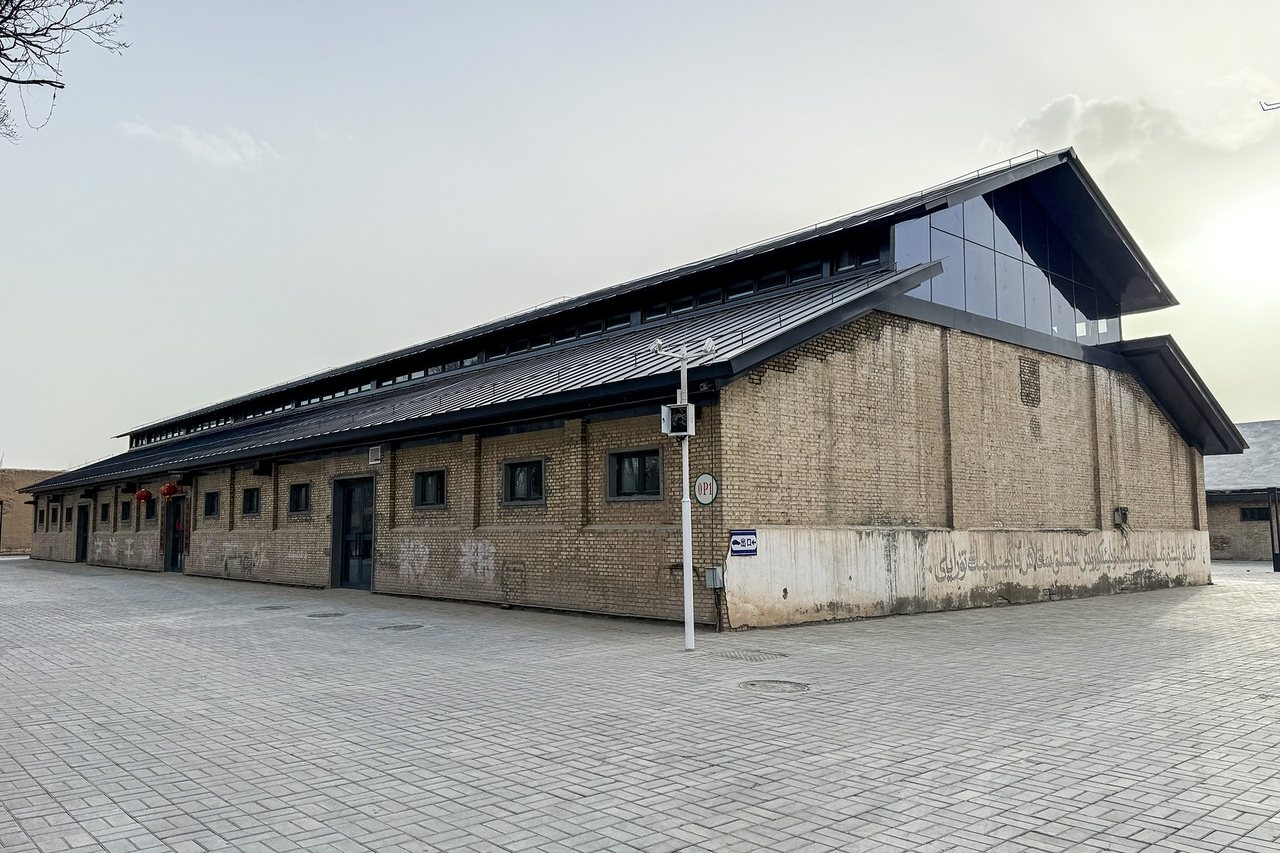
A former flour mill built in the 1960s offers another answer.
After its industrial life ended, the old buildings were adapted for exhibitions, reading and activities connected with traditional crafts.
An archaeological site can often be protected by changing as little as possible.
A craft survives in almost the opposite way.
An object can sit behind glass.
It needs to be practised, repeated, taught and allowed to change.
And so a twentieth-century industrial building now contains local practices with much older roots, while serving purposes created for the present.
The past has not survived unchanged.
It has simply found another way to remain part of the city.
Former Kuqa Flour Mill | A twentieth-century industrial site now serves new cultural uses.
Many Travellers Arrive by the Duku Highway
Not everyone comes to Kuqa looking for archaeology.
For many travellers, Kuqa first appears at the end of the Duku Highway.
The road crosses the Tian Shan southward from Dushanzi to Kuqa.
At first there are high mountains, grasslands and river valleys. The road climbs and falls, bends through mountain country and eventually crosses to the southern side of the range.
Then the landscape begins to change.
The air becomes drier.
Vegetation thins.
Bare rock takes on different colours.
Snow peaks retreat behind you.
Grasslands disappear.
The valleys begin to open.
And eventually, an oasis appears.
Duku Highway | After crossing the Tian Shan, the road reaches Kuqa on the southern side of the mountains.
After a long day on one of Xinjiang's most celebrated mountain roads, the city can easily feel like an endpoint.
The drive is finished.
The mountains have been crossed.
But once you enter Kuqa, that idea of an “end” becomes less certain.
This place has been a point of arrival for a very long time.
The Duku Highway is not a modern version of the ancient Silk Roads, and there is no need to romanticise modern driving by comparing it too closely with journeys made centuries ago.
Yet crossing the Tian Shan makes several old realities unusually easy to understand.
Routes follow possibilities through mountains and valleys.
People stop where water makes settlement possible.
Cities become connected to distant places partly because geography allows them to.
Roads change. Geography remains in the story.
Finally, Leave the City for Subashi
If you have time, end the journey by leaving Kuqa again.
Buildings begin to disappear.
Mountains return to the centre of the view, and the Kuqa River runs through the open land.
This is where the Subash Buddhist Ruins stand.
Subash Buddhist Ruins | Here, mountains, river valleys, routes and history return to the same scale.
Do not begin by trying to identify every surviving wall.
Look at the mountains first.
Look at the distance between the remains and the landscape around them.
Ask why a large Buddhist complex was built here at all.
Inside Kuqa, you have just seen history preserved beneath a modern road, reorganised inside museums and carried forward through streets and buildings that remain in use.
At Subash, the city falls away.
Words that sounded almost abstract before—mountain, water, oasis, route—become visible again.
The ruins, the river and the mountains no longer seem like separate things.
They begin to explain one another.
And suddenly Kucha becomes easier to understand.
Not simply as a collection of archaeological sites or museum objects, but as a place made possible by water, movement and geography.
That is why Subash works so well at the end of a journey through Kuqa.
Not because it must be the most spectacular place you see.
But because, once you arrive, everything that came before finally has a landscape around it.
Many travellers reach Kuqa on the Duku Highway believing they have arrived at the end of a road.
Walk into the city, however, and the boundaries between past and present begin to feel less certain.
The past has not survived intact.
Nor has it disappeared.
It remains as a layer of earth beneath a street, an object inside a museum, a door still opening onto an old lane, and an empty space beneath the mountains where something once stood.
Some cities place history safely behind walls.
Kuqa is more interesting because its different times remain scattered through everyday life.
Sometimes, understanding a city simply means walking one layer deeper into time.
IMAGE CREDITS & LICENCES