
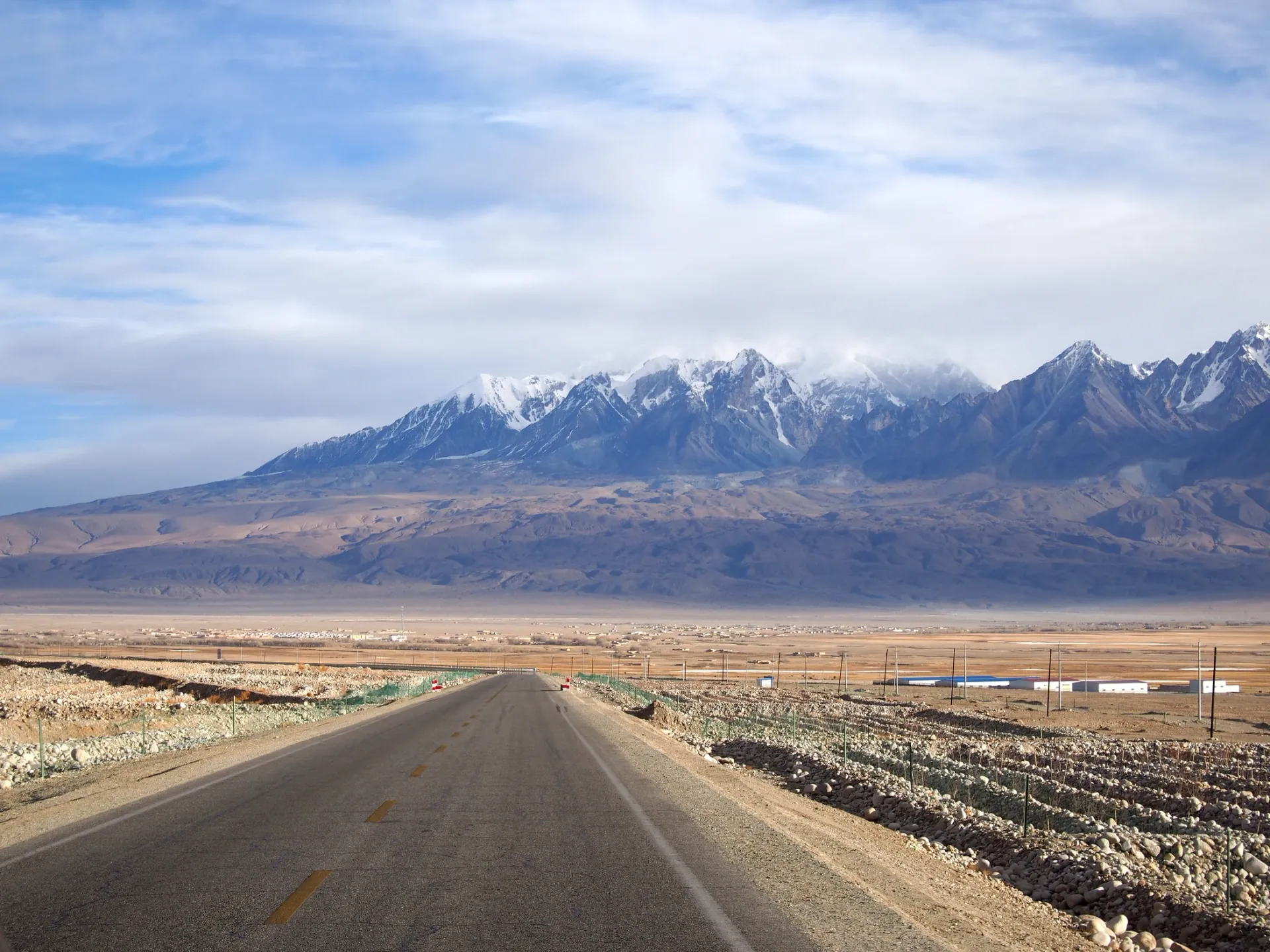
G314 runs about 300 km from Kashgar to Tashkurgan into the Pamirs with year-round operations. The corridor climbs from oasis to gorge, Baisha Lake, Karakul Lake and Muztagh Ata. Subashi service area on G314 is above 3,600 m.
When you leave Kashgar in the morning, everything still feels familiar.
The road is broad. The city slips gradually into the rear-view mirror. There are still trees, houses, fields and people walking beside the road.
Without the navigation screen, it is difficult to imagine that only a few hours later, the world beyond the windscreen will have changed scale completely.
G314 runs south-west.
At first, the Pamirs have not truly begun. The mountains are only a distant line. Then that line starts to rise.
The road continues. The city disappears. Villages become fewer. Trees thin out. The mountains move closer to the road.
Until, at some point, you realise there is no plain left ahead.
You do not suddenly arrive on the plateau. You climb into it.
The stages below follow the changes travellers notice first through the windscreen: space, colour, vegetation, air and scale.
After Kashgar, the World Begins to Narrow
Leaving Kashgar does not mean entering snow mountains immediately.
That matters, because a real journey into the high country needs a transition.
The city falls away first. The oasis grows thinner. The road begins to follow the Gez River into the mountains.
Rock closes in from both sides, compressing what had been an open sky into something narrower.
The car is still moving forward, but the view is already nothing like the one you had that morning.
Around Kashgar, the eye can travel a long way. In the gorge, your gaze begins to follow the bends in the road. What lies ahead is often hidden until the next wall of rock has passed.
The colours simplify too. Grey. Brown. Red. In places there is almost no visible vegetation at all, and the exposed rock sits directly in the sun.
The landscape is not gentle. For a while, it can even feel as though the road is leaving behind a world designed for everyday life.
Still, the road continues upwards.
The First White You See Is Not Snow
After enough time inside the gorge, the space suddenly opens again.
What people tend to remember first is the white sand.
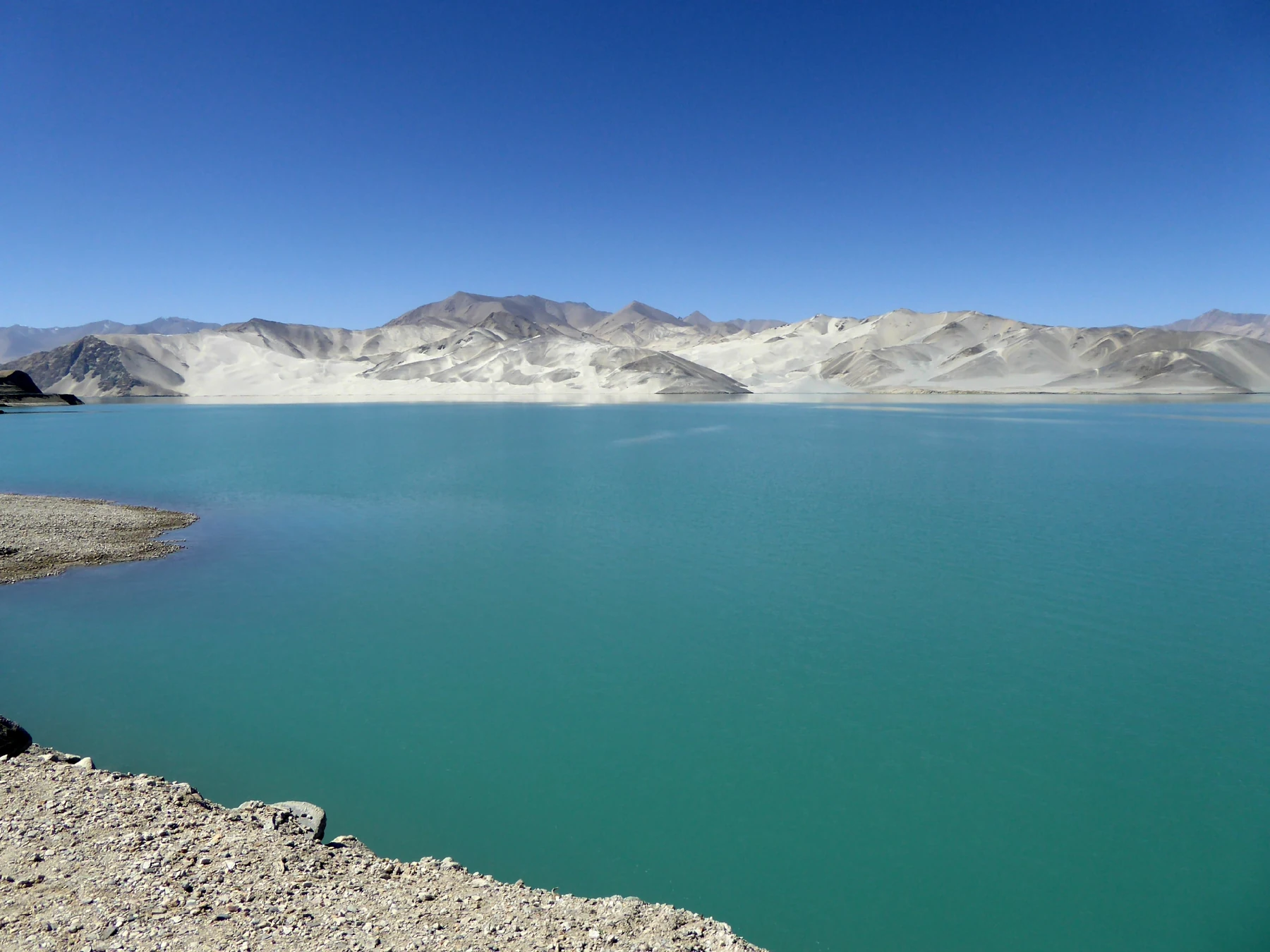
The view is no longer only grey-brown rock. Pale slopes appear at the foot of the mountains, and then water.
Baisha Lake and the light-coloured hills around it interrupt the heavier colours that have built up through the earlier part of the drive.
Most travellers do not begin with geology. The first reaction is much simpler: everything has suddenly become brighter.
A view that had been compressed by canyon walls opens out. The sky becomes large again. Wind returns.
The mountains are still high, but the road no longer feels trapped between rock faces.
If the gorge has been carrying you away from Kashgar, Baisha Lake is the first place that makes the next idea unmistakable: the plateau has begun.
The Snow Mountains Stop Staying in the Distance
Farther on, the snow peaks begin to enter the journey properly.
Not as a thin white line on the horizon, but larger and larger, closer and closer.
You can watch one through the windscreen for a long time and eventually notice that it hardly seems to move.
It is not because the car has stopped making progress.
The mountain is simply too large.
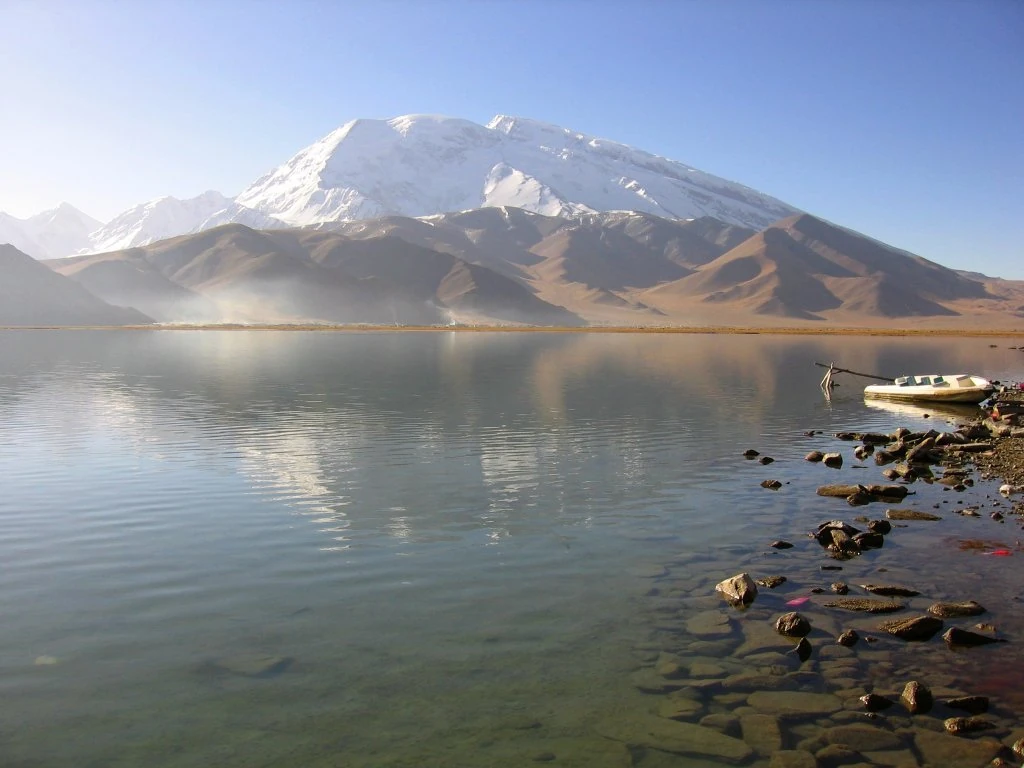
Karakul Lake appears inside that scale. Beyond the water is the high-mountain world of Kongur, Kongur Tiube and Muztagh Ata.
This is an easy place to stop. But the reason is different from S101.
On S101, you stop because the roadside keeps changing colour. Here, you stop to confirm scale.
Standing by the lake, you suddenly see how thin the road is, how small the vehicles are, and how the lake itself is not isolated at all. It belongs to a larger system of snow mountains, glaciers, grassland and plateau.
Muztagh Ata remains beside the road for a long time. You drive on and it is still there. Clouds hide it. Then it returns.
Your position keeps changing. The mountain seems not to.
It is not that the car has stopped moving.
The mountain is simply too large.
Altitude Is Not the Only Thing That Rises
Once the road is properly inside the Pamirs, the body often notices the change before the map does.
The air may feel drier. Walking quickly can make people slow down without thinking. You drink water more often.
Sunlight through the windscreen can still feel strong, yet the air outside may be cold when the door opens.
Jackets begin to go on, come off and go on again.
These small physical adjustments can make the plateau more memorable than any single elevation figure.
The Subash service area on G314 sits above 3,600 metres. At that point, a number on a sign begins to make sense in the body.
You begin to understand why a stretch of road that does not look very far on the map deserves a slower pace; why getting out of the car does not mean walking away quickly; why the same sunlight feels different here.
The plateau is not one attraction, and it is not announced by a single roadside marker.
It enters the body gradually over several hours.
At Tashkurgan, the Road Becomes Quiet Again
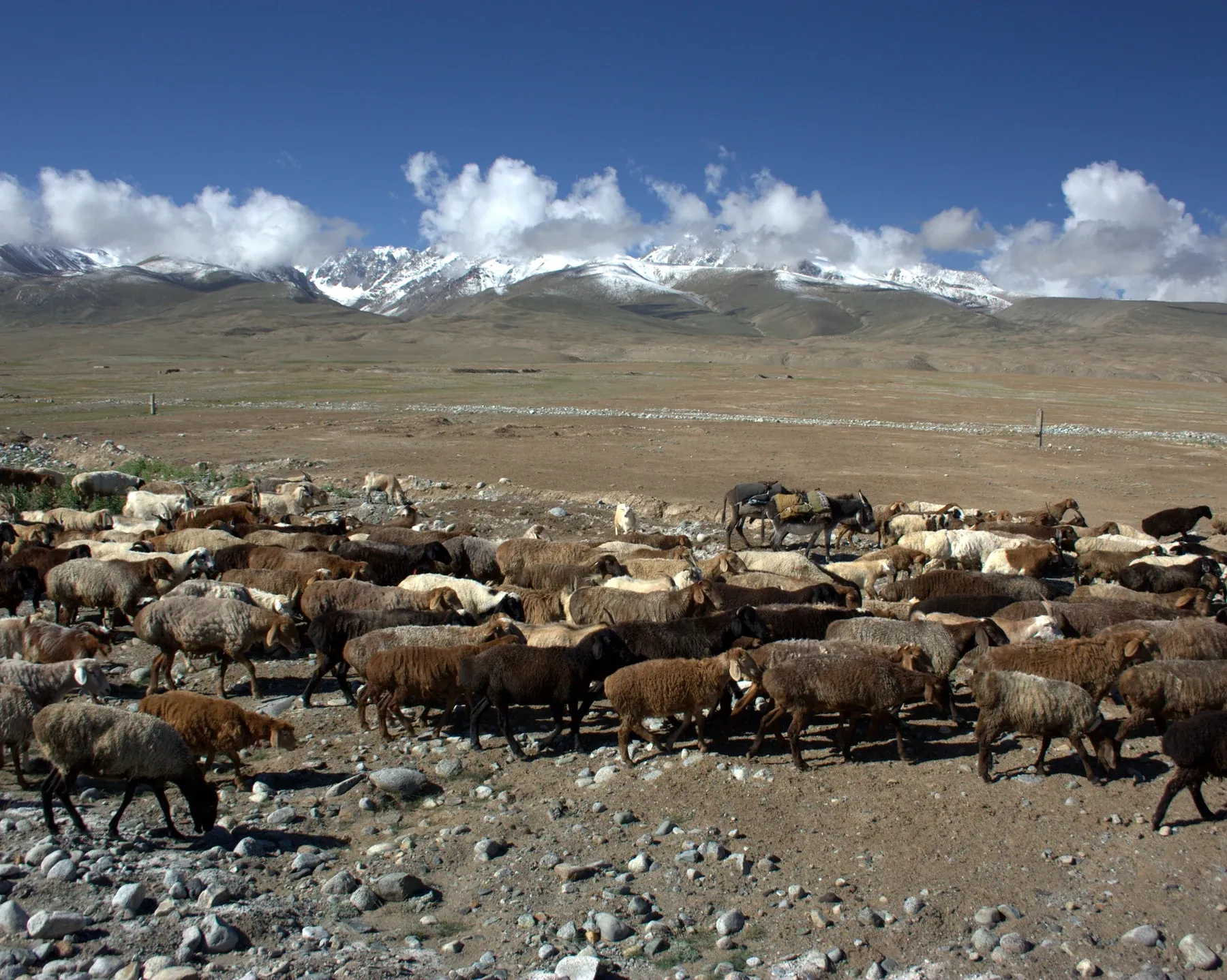
Continue south and the mountains begin to open into wider spaces again.
Rivers bend through grassland. Villages return. Trees appear beside the road.
After long stretches of grey, white and blue, green comes back into the view.
It is not the same green as Kashgar. It is not the dense green of an oasis city with fields and trees close together. Here, green occupies only the river valleys and the parts of the high landscape that can support it.
Tashkurgan appears inside that scale.
It does not end the journey in the way a large city might. Even after entering the county town, the high mountains remain ahead and the road itself can continue much farther.
For this journey, however, Kashgar to Tashkurgan is enough.
In only a few hours, something very clear has happened: the morning began in an oasis, midday entered a gorge, pale sand appeared, snow mountains moved closer, the air thinned, and by evening the traveller arrived in a high valley town.
On the map, it is simply movement from one place to another.
In the body, an entire world has slowly risen.
What Really Changes Is Your Distance from the Mountains
Looking back, it is easy to remember Baisha Lake, Karakul Lake and Muztagh Ata.
They matter, of course.
But if G314 is treated only as a road linking several famous sights, the most important part of the journey disappears.
The real changes happen between them.
When did the trees of Kashgar vanish? When did the gorge begin to narrow? When did the first truly enormous snow mountain fill the windscreen? When did walking start to feel better at a slower pace? When did green return?
None of these changes has a gate.
No sign announces: the plateau officially begins here.
They simply happen little by little with the road.
Several hours later, when you think back to Kashgar in the morning, it can feel like another world.
What makes G314 special is not simply that it reaches the Pamirs.
It lets you watch an oasis world turn, step by step, into a highland one.
Some roads connect two places.
This road does more.
It makes the transformation between two worlds the journey itself.
Some roads connect two places.G314 makes the transformation between two worlds the journey itself.