
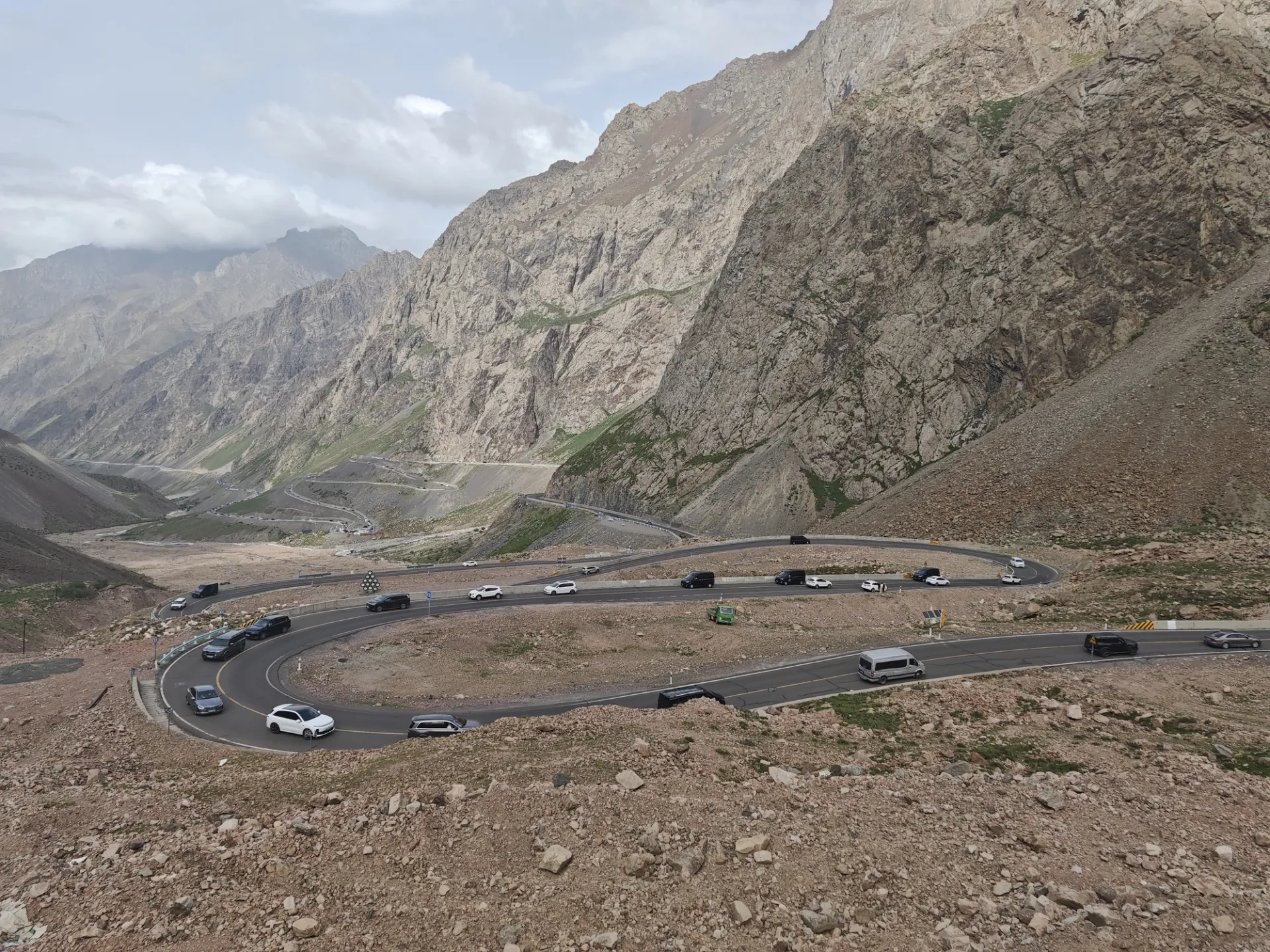
The Duku Highway (G217) runs about 561 km from Dushanzi to Kuqa across the Tianshan. It is typically open from mid-June to early October (summer limited opening). This corridor connects canyon, grassland and alpine scenery in one driving day.
When you leave Dushanzi, the Tianshan is still far away.
The road is broad and so is the sky. The city does not end all at once; it simply grows smaller in the rear-view mirror. Petrol stations, junctions, apartment blocks and roadside shops fall away one by one. Inside the car, nobody has gone quiet yet. Someone checks a camera. Someone looks at a phone. Someone asks how long today's drive is supposed to be. On the navigation screen, the route stretches south in a long line. At the far end is Kuqa.
More than five hundred kilometres.
On a map, that is just a number. Once the car starts moving, distance begins to acquire shape.
At first, the mountains are only background. They look close enough to suggest that half an hour might be enough to reach them. The road keeps going, however, and the mountains barely seem to move. Xinjiang often plays this trick: you can already see where you are going and still be a long way from arriving.
Then the conversation inside the car thins out. The mountains finally reach the road. The horizon stops lying open. Rock walls rise on either side, the river runs lower in the valley, and the road begins to turn. A few minutes ago you could see far ahead; now each bend gives you only the next piece of road.
This is where the Duku Highway really begins.
Current Travel Intelligence · 2026
Last verified · 08 Aug 2026The Road Begins to Decide How You Travel
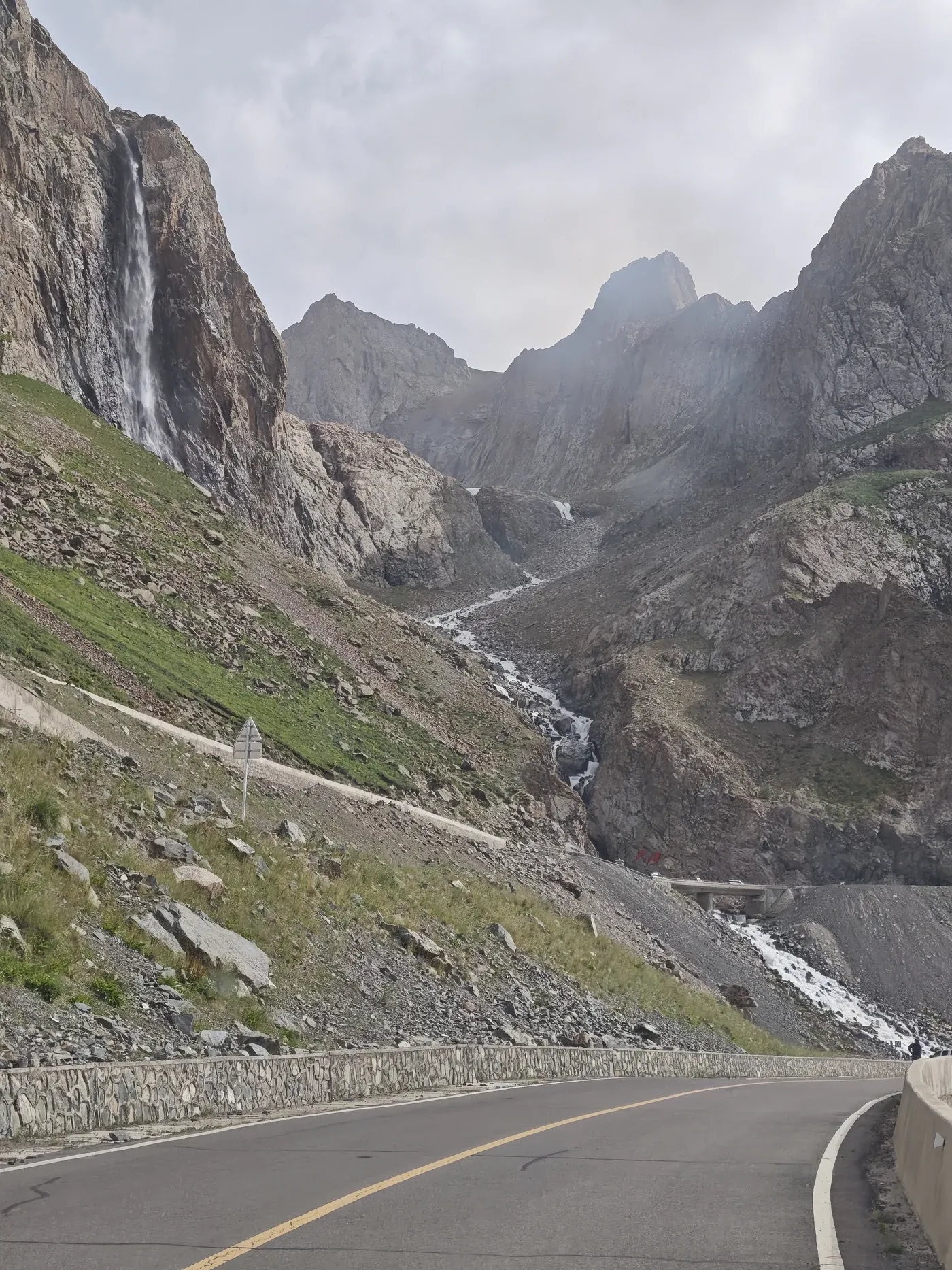
When you first leave the city, you are choosing the road. Once you enter the Tianshan, the relationship slowly reverses.
The valley narrows and the car slows. A vehicle ahead turns a corner and disappears behind the mountain. The road searches for whatever space the valley will allow: pressed against rock, carried over water, bending repeatedly around slopes that leave almost no room to continue.
None of these curves exists to make the journey more beautiful. They are simply the choices the road has had to make in order to go on.
People inside the car begin to adjust as well. Phones are checked less often. The windscreen becomes more interesting. The driver works more constantly — brake, steer, accelerate, slow again. Doors and glass keep the mountain air outside until somebody steps out at a stop and realises that the temperature is no longer the one they left behind in Dushanzi.
Someone reaches for a jacket.
That usually tells you the altitude is rising before any explanation does.
Higher up, patches of snow can remain beside the road even in summer. Water comes down from somewhere above. The air cools. The colours on the slopes change. Someone checks the elevation on a phone. Someone else asks how long it is to the next stop.
On a long road journey, few questions are more honest than this one: how much farther?
Xinjiang makes you ask it often. Not because the roads are necessarily poor, but because the distances are genuinely large. A map compresses hundreds of kilometres into a few centimetres. The body has to recover those kilometres one by one.
The Duku Highway makes that especially clear. You cannot skip the change in altitude the way you do on a flight, nor can you let the mountains disappear beyond the windows of a fast train. The road follows the shape of the range. Height rises gradually; weather and vegetation change with it.
Later, people may summarise the Duku Highway with the familiar phrase 'four seasons in one day'. In the car, the experience is less tidy. You simply notice that it is colder. Then snow appears where there had been none. Farther on, the slope changes colour. Some time later, the view changes again.
The body understands first. The explanation arrives afterwards.
In the Mountains, a Day Acquires Length
Long drives have their own sense of time.
Two hours in a city are easily broken into separate tasks: a meeting, lunch, messages, waiting for someone. On a road, time becomes continuous again.
The car keeps moving. Morning passes almost unnoticed. The sun shifts. Someone falls asleep and wakes again. At a stop, everybody gets out to stretch, then climbs back in. The door closes and the journey resumes.
Outside, the mountains have never stopped changing.
For a while there may be rock on both sides and a river below. Much later, the view opens without warning. Then the road begins to climb again. More than once, you think the highest point must already be behind you, only to see another rise ahead.
That is one of the Duku Highway's quiet corrections to the imagination. We tend to picture a mountain as a single barrier: up, top, down, finished.
The Tianshan is not like that.
It is not a wall but a vast mountain system, with valleys between ranges, rivers beyond high ground, and one pass leading into another landscape rather than neatly out of the mountains. There is no single moment on the Duku Highway when you can say with certainty: now the Tianshan is over.
You think the climax has passed. The road keeps going.
That length is part of what makes the journey compelling. After several hours, people stop trying to attach a name to every beautiful view. Early in the day someone may ask, 'What is this place called?' Later, the question comes less often.
There are too many mountains. The valleys are too long. Something new keeps appearing beyond the glass.
Eventually you accept that not every landscape needs a name in order to remain in memory.
Sometimes it is only a patch of light after a bend. A section of road running close to the snowline. Cold air hitting your face at a stop. Or the sight, in the rear-view mirror, of a road you have just driven being hidden again by the mountain.
These are often the hardest parts of a road journey to preserve.
They are not destinations. They are what the journey is made of.
Some distances take a second to read on a map.
The body has to travel them kilometre by kilometre.
Beyond the Pass: Another World, the Same Mountains
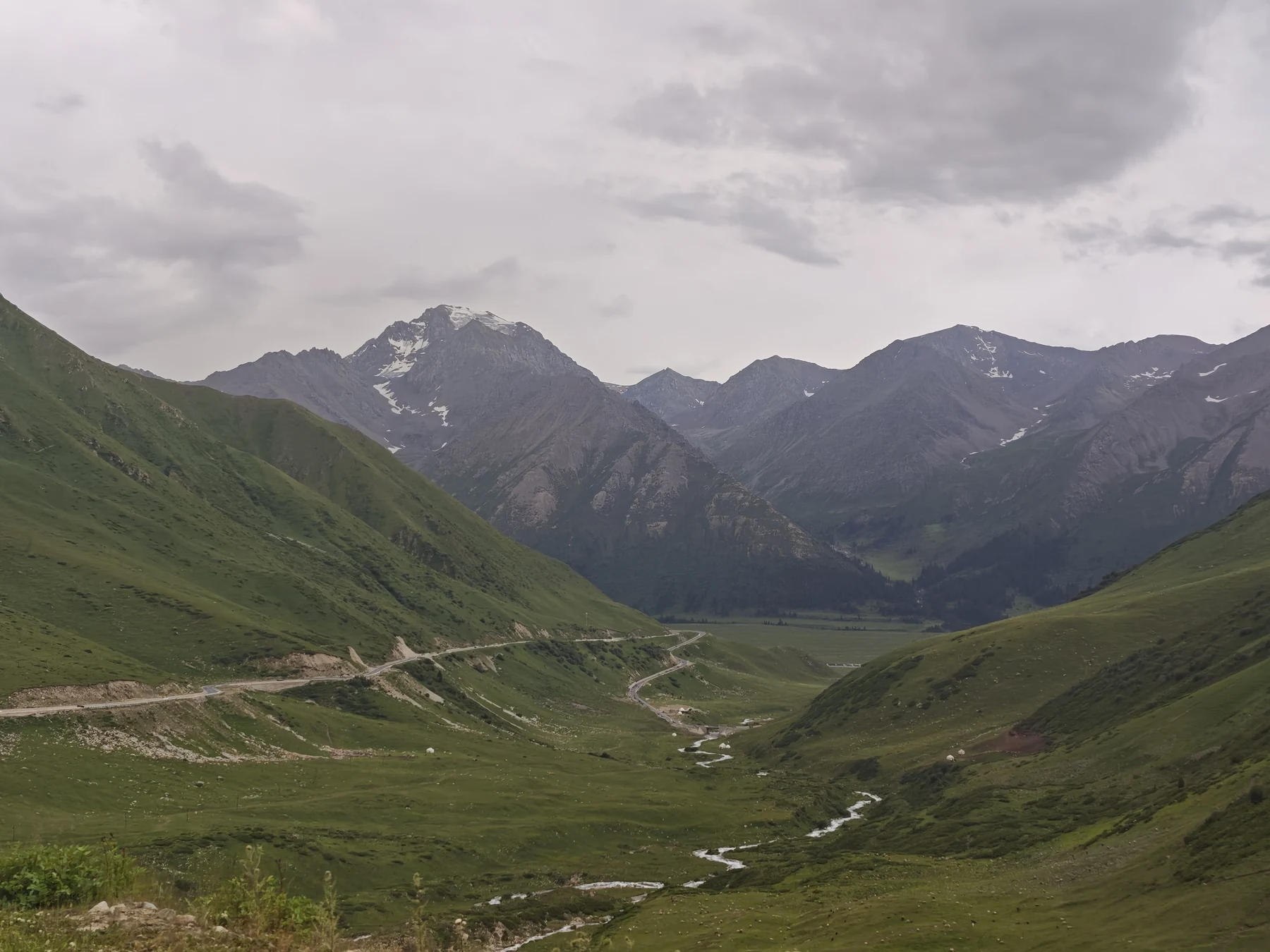
Farther south, the Tianshan slowly changes character.
Rock walls that had crowded the road begin to fall back. Valleys widen. Green becomes more generous. Forest, meadow and water start to wrap the mountains in different colours. The windscreen no longer holds only cliff faces and sharp bends; the eye can travel farther again.
Bodies relax with the road. Speed becomes steadier. Conversation returns. Someone wakes from sleep, looks outside and asks where you are now.
Names such as Nalati and Bayanbulak begin to appear on road signs, navigation screens and itineraries. Yet when you keep driving, they do not arrive like separate pins on a map.
One place becomes another gradually.
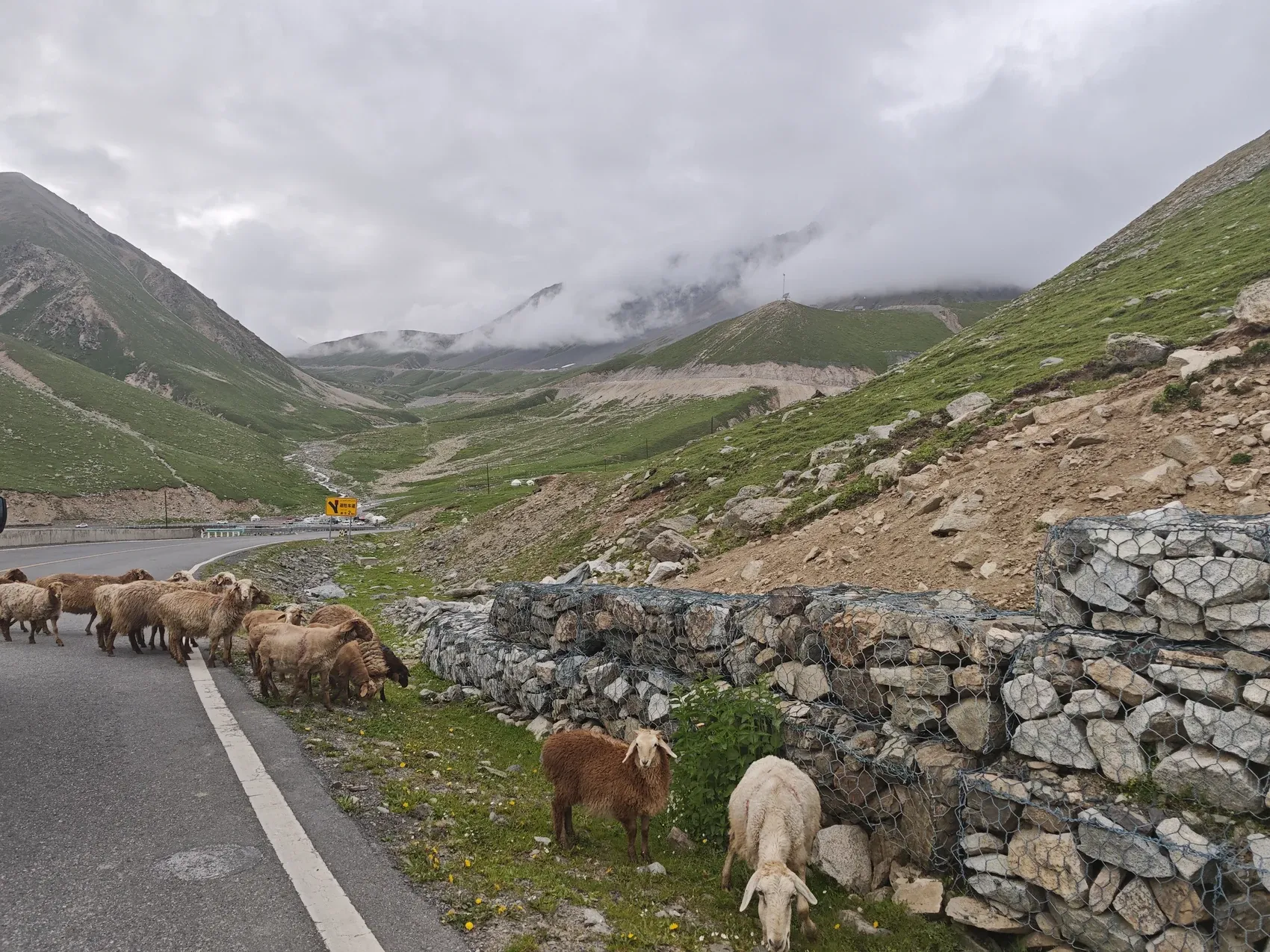
As forest thins, grassland takes over. The mountains move farther away and the sky expands. Rivers curve through open ground. Livestock and vehicles become small in the scale of the valley.
If the first hours of the day felt like crossing the mountains, this part feels more like travelling inside them.
The Tianshan no longer appears only as rock pressed against the windscreen. It still determines almost everything: where the water comes from, why grass can grow, where pasture is possible, where the road can pass.
None of this needs to be explained immediately. Stay in motion long enough and the connections begin to become visible by themselves. The changes in scenery are not separate performances arranged for travellers.
Snow becomes water. Water enters the valleys. Valleys allow vegetation to spread. Grassland, in turn, supports another way of living.
The mountains have not disappeared. They have simply changed the way they are present.
That is one of the Duku Highway's most rewarding qualities. Again and again, you think you have left one landscape behind. Later, you realise that many of them belong to the same system — different faces of the same mountains.
By Afternoon, the Green Begins to Leave the Window
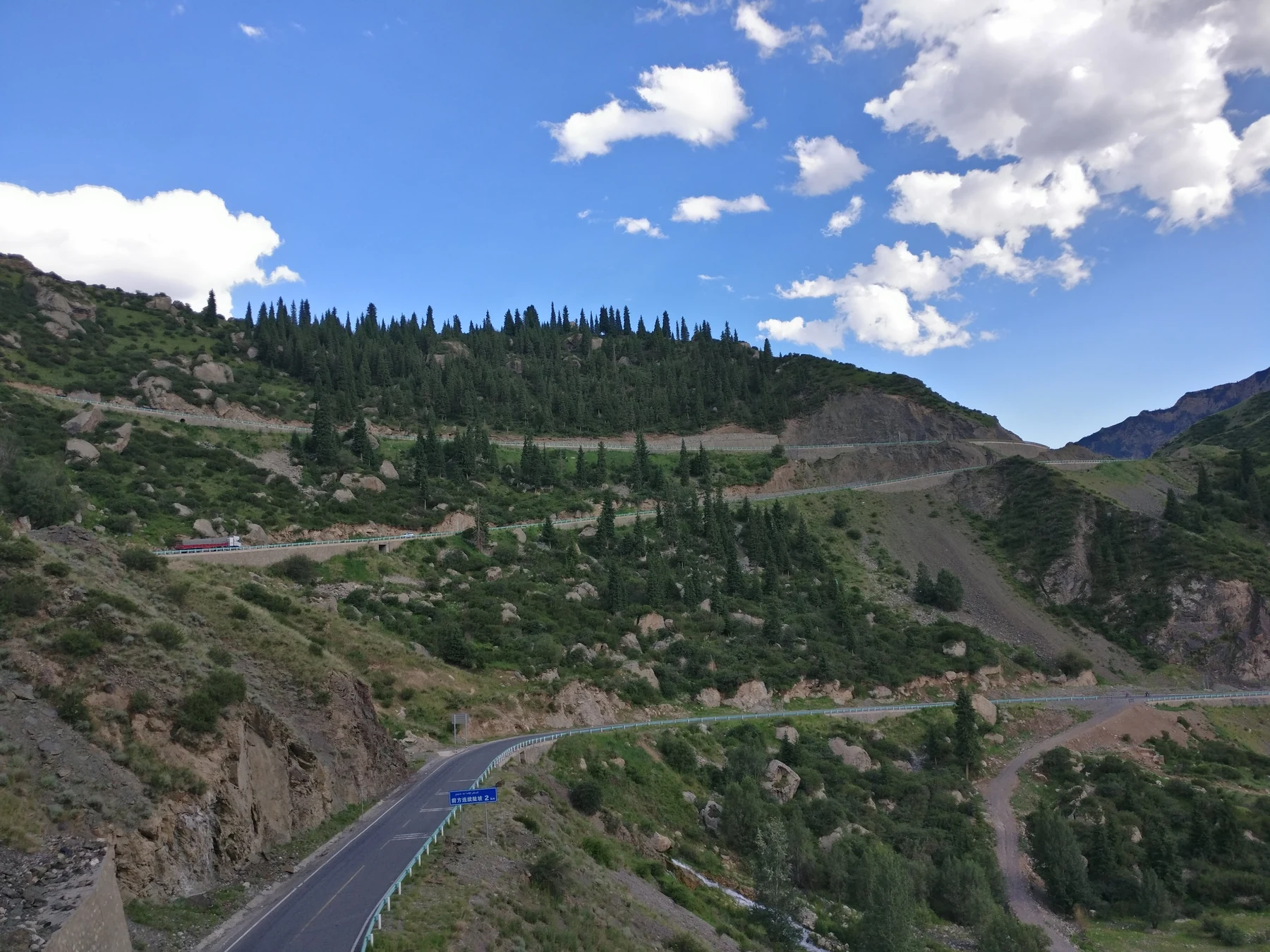
By afternoon, a long road journey develops a mild fatigue.
At the beginning of the day, every stop feels worth noticing. Later, you mainly want somewhere to stretch your legs, drink water, get back in and keep going. The distance remaining on the navigation screen falls steadily, but it is still large.
Then the Duku Highway changes again.
Continuing towards Kuqa, green begins to withdraw. There is no ceremonial boundary. No sign announces that southern Xinjiang begins here.
At some point, you simply notice that there is less grass. Later, the mountain itself appears more exposed. The colours shift.
Grey. Brown. Red.
Rock strata cut by wind and water reclaim the view. The air feels drier. The jacket that was necessary higher up may come off again at a lower elevation.
If you showed someone photographs from the northern and southern sections of the Duku Highway without explanation, they might struggle to believe the images belonged to the same road.
One world contains snow, river valleys, forest and pasture. The other is built from exposed rock, dry gorges and the harsher colours of land approaching the basin.
Inside the car, nobody turns a page for you. There is only the road continuing forward between the two.
That is one of the great differences between long-distance travel and sightseeing. Photographs are good at preserving contrasts. Roads allow you to see how one condition becomes another.
Green does not vanish at once. Dryness does not begin at a line painted on the ground. Change takes tens of kilometres, sometimes hundreds. You have to remain inside the movement to see it happen.
By now, the mountains you saw from Dushanzi in the morning seem difficult to compare with those outside the window. Yet they are still the Tianshan.
A traveller does not need to remember every geographical term for the lesson to register. Much of it is simpler than that: you leave in a T-shirt, put on a jacket, then remove it again. You begin among dry slopes, meet snow, enter grassland, and later watch the green slowly disappear.
Sometimes the experience of a single day explains Xinjiang better than a map.
As the Day Ends, the City Returns
Approaching Kuqa, people start checking the navigation screen more often.
Not because the scenery has stopped mattering, but because after a full day in the car, the question of how many kilometres remain becomes practical again.
The road straightens. The mountains begin to retreat. Traffic increases. Buildings, petrol stations, restaurants and ordinary urban infrastructure return to the roadside.
Mobile signal becomes reliable. Messages arrive with it. Phones begin to ring and vibrate again. The everyday life that had faded out during the day reconnects itself.
At this point, people often talk less rather than more.
When you left Dushanzi in the morning, the Tianshan was still ahead. Now it is behind you. Too much has happened in between to be reduced to a single viewpoint or scenic stop.
You remember a pass. A river. A place where everyone got out of the car. A stretch of pasture. A bend whose name you never knew. You remember being tired. Someone sleeping for hours. The moment you first felt cold. The moment you stopped feeling cold.
That is how long road journeys settle in memory. What remains is not always what was written on the itinerary.
After reaching Kuqa, your first thought may not be to interpret the Tianshan at all. It may simply be dinner, a shower, charging the phone, and sitting in a room that has finally stopped moving.
Only after the journey ends does the difference between morning and evening become fully visible.
At departure, you knew only that you were going to cross the Tianshan.
By night, you have some idea of what 'crossing' actually means.
It is not merely passing through a famous mountain range. For hours, the mountains have controlled your speed, temperature, view and direction. They have bent the road, released rivers, allowed grass to grow, taken the green away again, and made two worlds that maps label northern and southern Xinjiang appear as one continuous day.
The Next Morning, the Road Becomes Memory
The next morning, the Duku Highway is no longer something happening around you.
It becomes a line on the map again. 561 kilometres. Dushanzi to Kuqa. Part of G217.
Photographs on the phone break the day into fragments: snow mountains, valleys, pasture, gorges, the road itself, and a few careless images taken during stops.
Once you have driven the route, however, you know that its most important qualities are difficult to keep in photographs.
They are the distances between the photographs.
The hours required for one view to become another.
The fact that the car keeps moving while the world gradually changes its form.
That may be why roads so easily become part of the journey in Xinjiang. The distances are too long, the mountains too large and the basins too wide for the time between destinations to be treated as empty transport.
Going from one place to another often means crossing a geography.
The road preserves that process. You cannot fast-forward it. You cannot look only at the result. You have to keep going.
So after the Duku Highway, what remains is not only a list of places you reached.
You remember how the world outside the windscreen slowly became another world.
And the Tianshan is the reason it happened.
Perhaps the Duku Highway is not really about 'conquering' a mountain at all. The mountain does not care who passes through. What changes is the traveller's understanding of distance.
In the morning, more than five hundred kilometres is a number on a screen. By evening in Kuqa, it has become snow, wind, rivers, grassland, rock, tiredness, stops, bends, and an entire day that never quite stopped moving forward.
You come away knowing something simple:
Some places cannot be understood by arriving.
You have to be on the road.
In the morning, five hundred kilometres is a number on the navigation screen. By night in Kuqa, it has become snow, wind, rivers, grassland, rock, tiredness, stops and bends.Some places cannot be understood by arriving. You have to be on the road.