
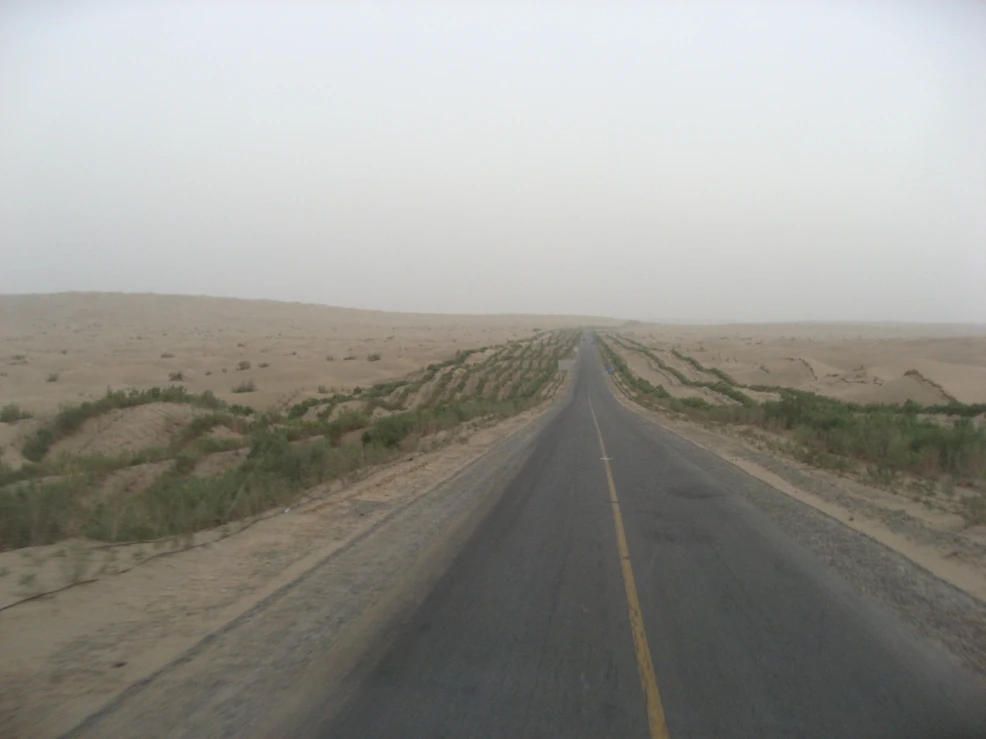
The Taklamakan crossing covers about 552 km with year-round operations. It moves from oasis into repeating dunes, shelterbelts and long stretches without reference points until trees and settlements return on the far side.
At first, entering the Taklamakan is exciting.
The first real dunes appear. The colours outside the window suddenly become simpler. Someone begins taking photographs. Someone else presses a phone against the glass, trying to capture the moment when the road seems to disappear into the sand.
Then the car keeps moving.
Half an hour later, there are still dunes.
An hour later, there are still dunes.
After a while, it becomes difficult to tell how different the sand outside the window really is from the sand you saw before.
That is when the desert truly begins.
Not because you have finally seen sand, but because familiar reference points are starting to disappear.
The First Thing to Disappear Is a Sense of Reference
The Taklamakan does not begin with one particularly beautiful dune.
The real change happens more slowly.
Towns fall behind. Trees become fewer. Buildings disappear. The land on both sides of the road opens out until almost everything in sight has been reduced to one road, expanses of sand and a very distant horizon.
On an ordinary journey, the outside world helps us measure distance. A village has passed. A mountain is closer. A river is behind us.
Inside the desert, those points of reference gradually disappear.
The dunes are changing all the time, of course. Wind reshapes their edges and light moves across their shadows. But from the car, the larger picture begins to repeat itself.
A road ahead.
Sand on both sides.
A huge sky.
Then the same again.
That repetition is not a flaw. It is the first step towards understanding the scale of the desert.
Two Hours Later, the Landscape Still Seems the Same
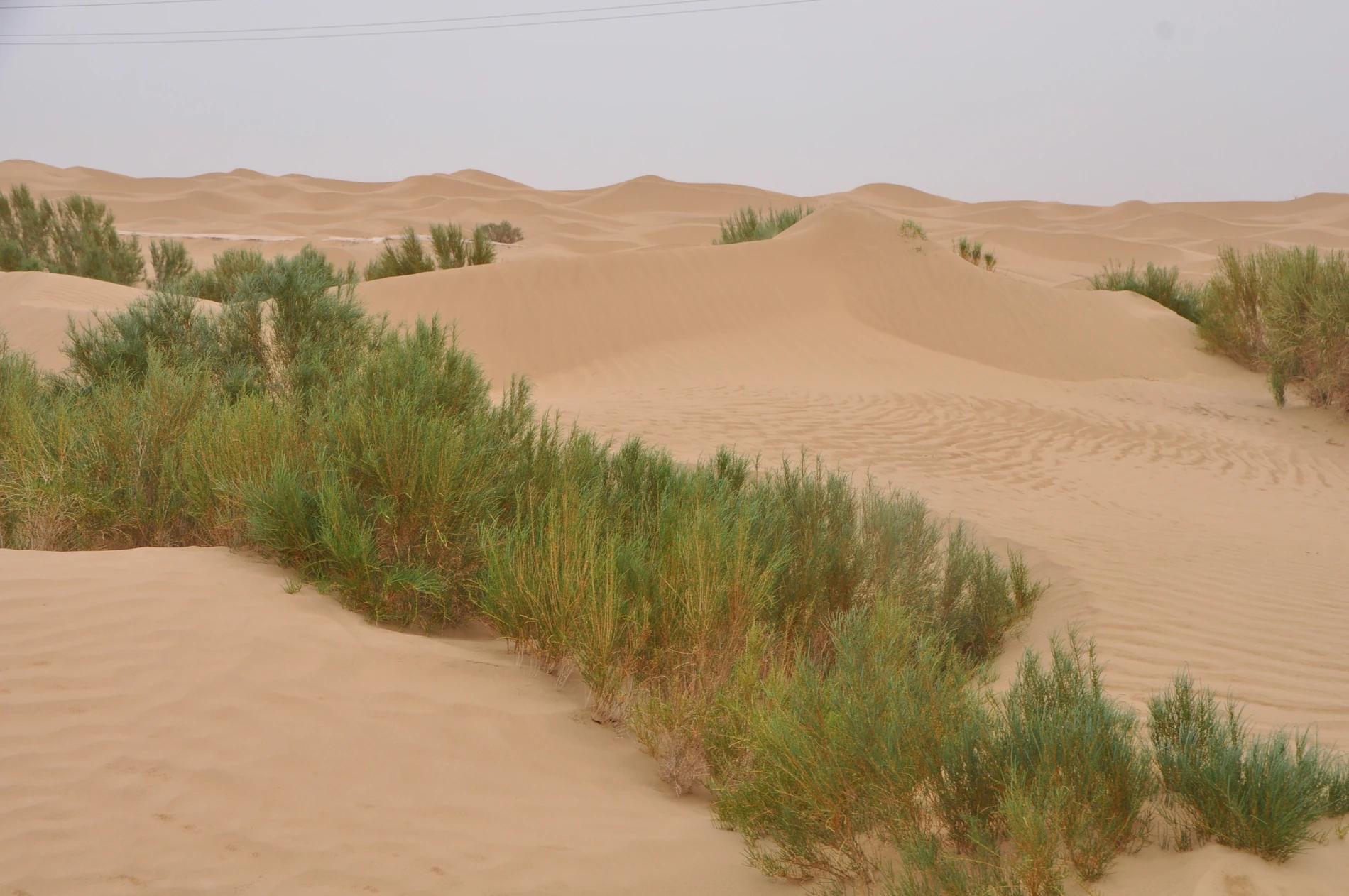
At the beginning, people look for the most beautiful dune.
Later, that question begins to lose its meaning.
Not because the dunes are less impressive, but because there are too many of them.
One follows another. One field of sand gives way to the next. Light shifts from one side of the road to the other and shadows lengthen, but the horizon remains far away.
The number on the navigation screen keeps falling, yet the body receives very little visual confirmation that distance is being covered.
So time becomes the new measure.
You remember when the car last stopped. You remember how much water you have drunk. You notice that one album has finished and another has started. Eventually, someone asks the inevitable question: how much farther?
A true desert road movie does not need a new landscape every few minutes.
Its power comes from repetition.
When similar images continue for long enough, you finally understand that you are not looking at a patch of dunes. You are crossing an enormous geographical space.
The numbers on the navigation screen keep changing.
The view outside seems not to.
The Most Unexpected Colour in the Desert Is Green
On the classic Luntai–Minfeng desert highway, one of the strangest contrasts appears after you have travelled deep enough into the sand.
The desert is still desert.
But a low strip of green begins to continue along both sides of the road.
It is not the shade of an urban avenue, and it is not a natural oasis. It is a protective shelterbelt running beside the highway.
It is narrow. From a distance, it can look as though someone has drawn a line through the desert with a pencil.
But the line continues for a very long way.
Public records in 2025 described roughly 436 kilometres of ecological shelterbelt along the classic Tarim Desert Highway, with an overall width of about 75 metres and irrigation supported by wells along the route.
For the traveller, the point is not to memorise those numbers.
It is to realise that for a road to keep existing among moving dunes, it has to be continually maintained.
The road is not simply laid on top of the sand.
It has to live with the sand.
Even a Petrol Station Starts to Feel Like a Landmark
The desert changes the value of ordinary things.
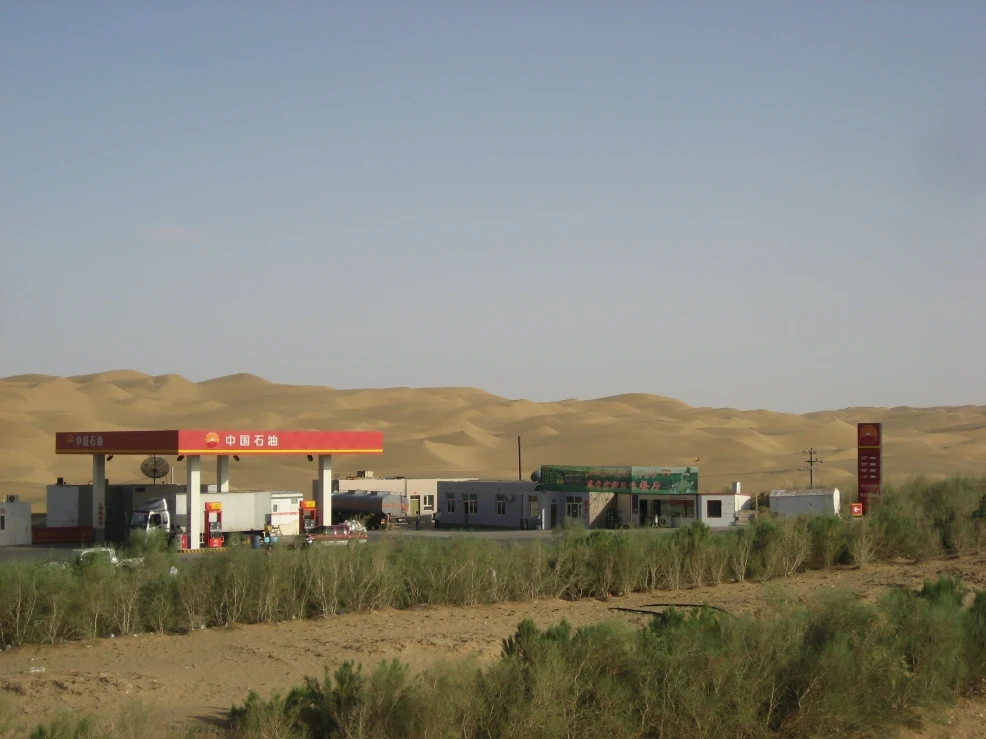
At the edge of a city, a petrol station rarely deserves a second glance.
Deep inside the Taklamakan, it feels different.
A sign. Several parked cars. Toilets. Water. Cold drinks. Someone stretches their legs. Someone checks the fuel. Someone stands beside an open door looking at the sand in the distance.
Things that would normally disappear into the background suddenly become very specific.
Because for long stretches before and after, there may be very few places where the journey can pause.
That is why the memories of a desert crossing are not always the grandest images.
It might be a bottle of cold water.
It might be the heat that hits you when the car door opens.
It might be five minutes at a nameless stopping point with no scenic significance at all, before everyone gets back inside.
The door closes.
The air-conditioning starts again.
The road continues towards the horizon.
There Is More Than One Way Across the Taklamakan
This is a thematic corridor page rather than a single-route page. Different crossings serve different oasis cities. The essential structure is kept here; route choice, same-day road conditions and fuel planning belong in a separate Travel Intelligence layer.
Luntai → Minfeng
552 KMThe classic Tarim Desert Highway; about 446 km through shifting desert
Alar → Hotan
424 KMNow an important desert corridor on G580
Yuli → Qiemo
334 KMAbout 307 km of the route crosses desert terrain
Tumshuq → Kunyu
—Its opening brought the number of major north–south desert crossings to four
When Trees and Houses Return, You Realise the Desert Is Ending
One of the most interesting moments in a desert crossing is the moment it begins to end.
That ending is rarely sudden either.
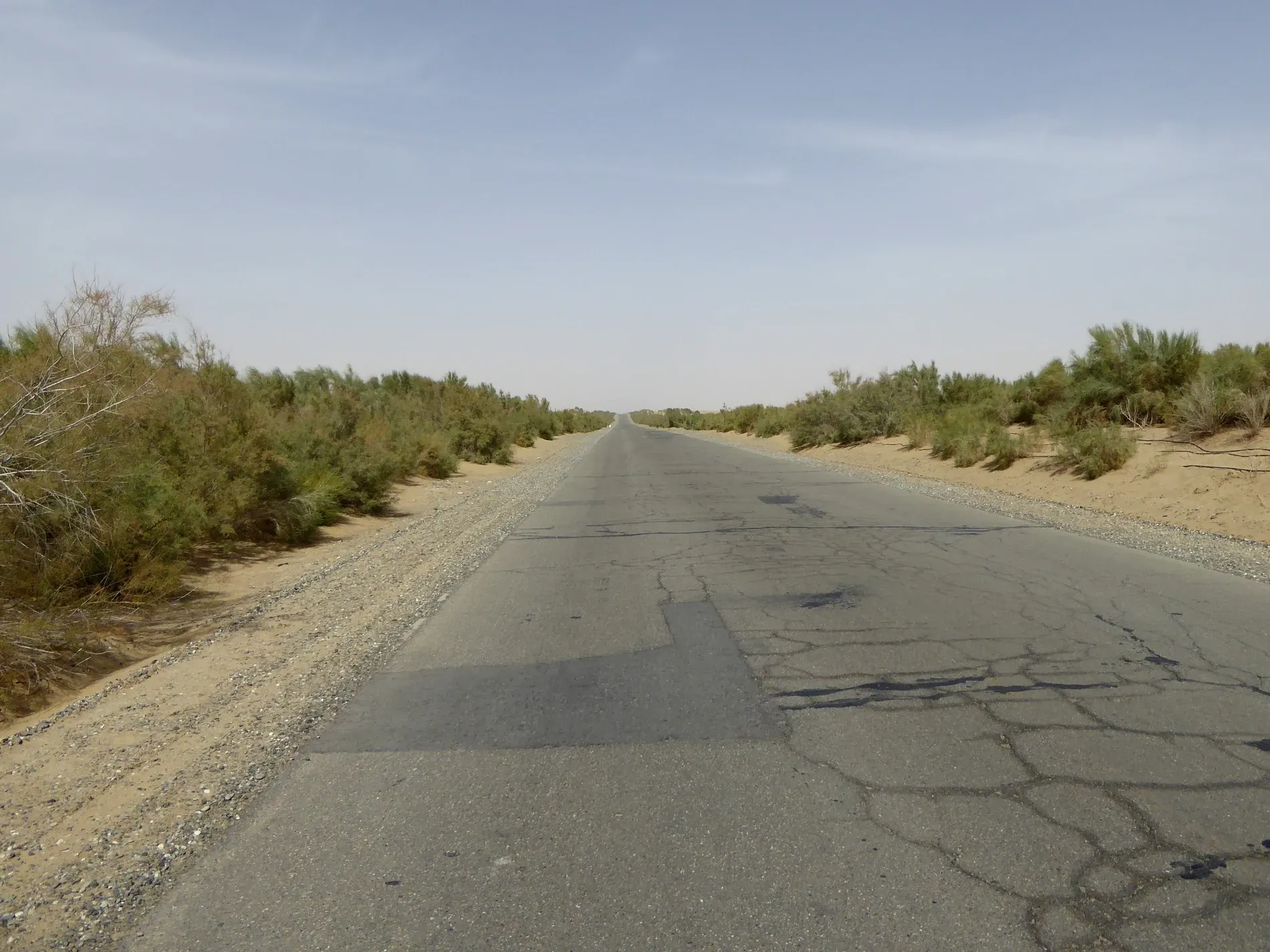
At first, there is simply a little more vegetation beside the road.
Then the ground is no longer entirely sand.
Trees appear in the distance.
Power lines, houses, fields and more vehicles gradually return to the view.
The ordinary things you left behind in the morning feel unexpectedly concrete after several hours inside the desert.
You have reference points again.
Today, the Taklamakan is not crossed by only one north–south road. Public transport records describe several major corridors: the original Luntai–Minfeng road, the Alar–Hotan road, the Yuli–Qiemo road and the later Tumshuq–Kunyu road. They connect different oases, but the experience they share is remarkably similar.
You enter from one side.
For a long stretch in the middle, the world is reduced to road, sand and sky.
Then, on the other side, the inhabited world begins to return.
What stays with you is not simply the thought: I saw the desert.
For several hours, you were inside it.
Those are not the same thing.
What stays with you is not simply, ‘I saw the desert.’For several hours, you were inside it.