
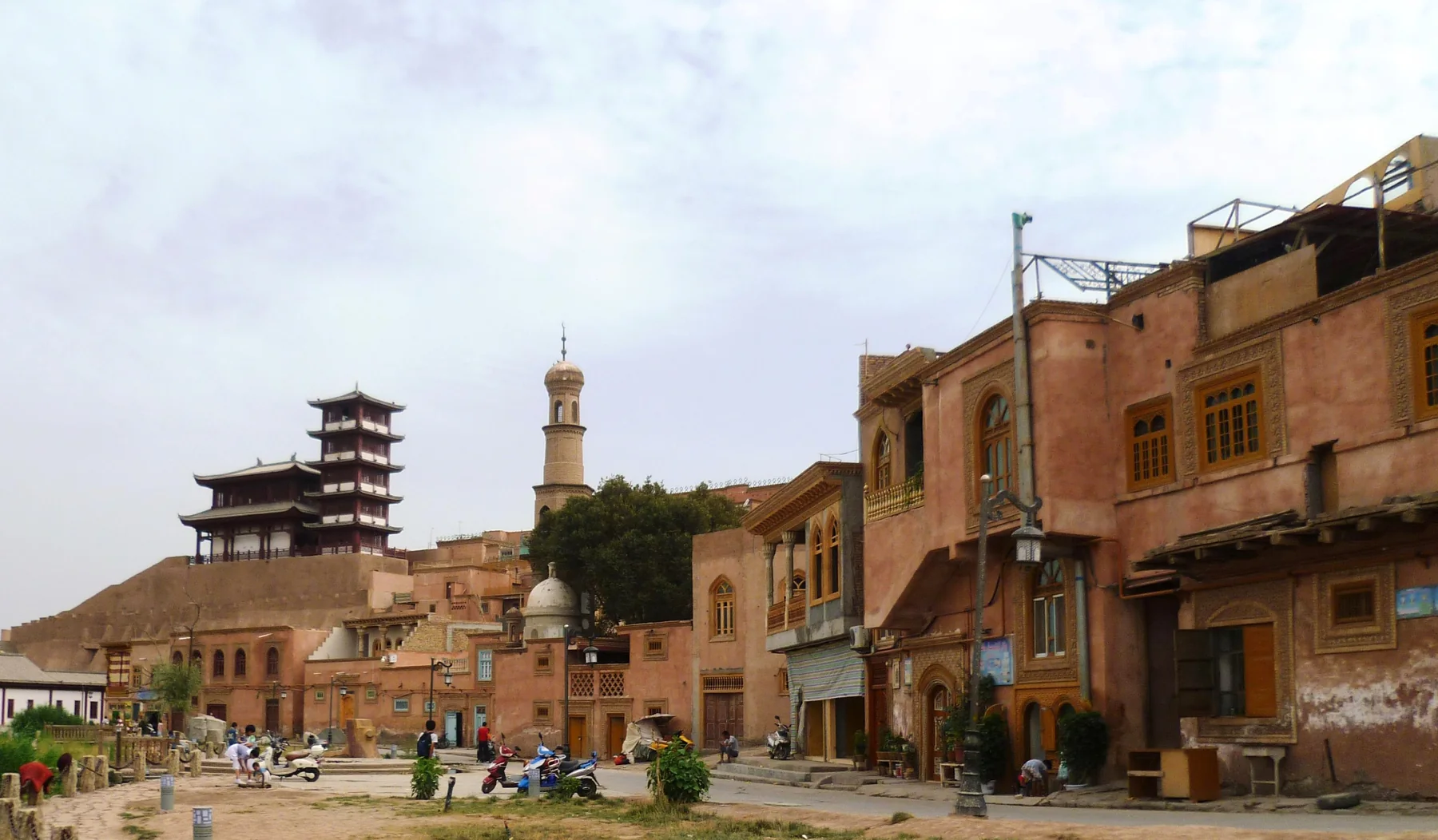
Living Silk Road Ancient City
Kashgar
Read Kashgar through its oasis setting, lanes, workshops, teahouses, markets and the ordinary rhythms that continue beyond the Old City.
Kashgar is a living oasis city at the western edge of the Tarim Basin—old-town lanes, workshops, teahouses and markets where everyday life continues beyond the tourist frame. It is the principal gateway to southern Xinjiang and road journeys toward the Pamirs.
Most first-time visitors to Kashgar spend part of the journey waiting for the ancient city—the Old City, as it is referred to here—to appear.
From the airport, the road passes broad junctions, apartment blocks, schools and new commercial streets. The navigation system repeats unfamiliar place names, while the carved doors, earthen-coloured walls and narrow lanes of the traveller’s imagination remain out of sight.
Only as the vehicle approaches the older part of the city do the streets begin to tighten. Buildings move closer together. Balconies, shopfronts and turning lanes enter the frame. At last comes the quiet sense of confirmation:
This is Kashgar.
The traveller slows down. He looks for traces of the Silk Roads, for a doorway worth photographing, and for the kind of scene an old city is expected to provide.
Then a child with a school bag walks through the photograph.
He does not stop.
This is not his attraction.
It is his way home.
Travellers come to Kashgar looking for the past. The city keeps placing the present in front of them.
Travel Intelligence · 2026
Last reviewed · August 2026Before You Enter the Old City
Before stepping into the lanes, it helps to understand why a city grew here at all.
Kashgar is, first of all, an oasis city.
It lies on the western edge of the Tarim Basin. Beyond the plain, mountain systems shape both water and movement. Snow and ice melt in the high country and feed rivers that reach the dry lowlands, making fields, orchards, settlements and urban life possible.
In this landscape, water is not scenery.
It decides where people can remain.
Roads decide who can arrive.
Routes west lead towards Central Asia. To the south, mountain corridors climb towards the Pamir Plateau. To the east, a chain of oasis towns links Kashgar with the wider Tarim Basin and other parts of the Xinjiang Uygur Autonomous Region.
People travelled these routes with goods, but also with techniques, languages, food, beliefs and news. The Silk Roads were never one permanent road. They were a changing network, altered by seasons, politics, safety and demand.
Water allowed people to stay. Roads kept bringing others in.
Kashgar grew between the two.
Arriving by air or rail may feel far removed from the age of caravans, yet the city still follows a recognisable logic. It remains a place of arrival, exchange, pause and onward departure.
The Old City is simply the most visible part of that longer story.
Early Morning, Before the Old City Becomes a Sight
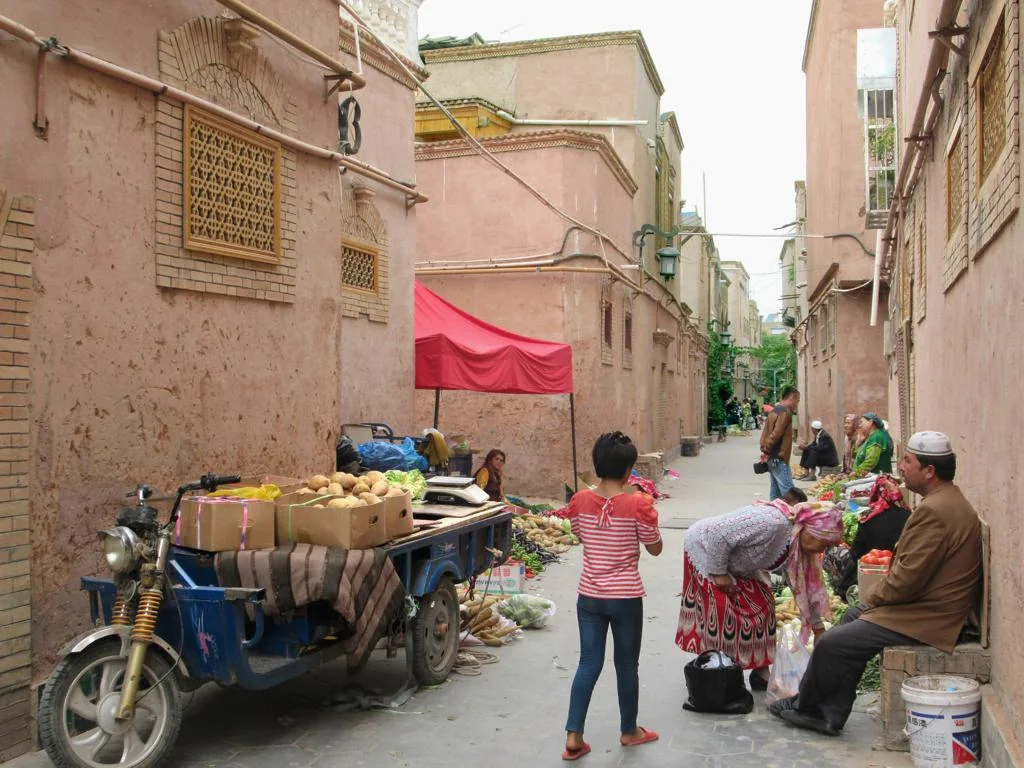
Go early.
Not because you can expect to have the lanes to yourself, but because morning reveals how a day of tourism is assembled.
Some shops are only beginning to open. Traders carry goods outside, sweep their steps and check signs. Fresh rounds of nang, the local flatbread, give off a brief warmth. Electric scooters negotiate the narrow gaps. Children head towards school, largely indifferent to whether the walls look good in photographs.
An hour or two later, the same street changes.
Tour guides can be heard. Travellers in rented costumes appear. Visitors wait beside carved doors while a photographer clears the frame. A junction built for movement becomes, for a few minutes, a set.
The Old City is commercial, and parts of it are unapologetically so. Rows of similar souvenirs, staged photographs and repeated shopfronts can quickly wear down the surprise of arrival.
But commerce is not proof of falsehood.
A neighbourhood in which people still live also needs jobs and income. The useful question is not whether Kashgar satisfies an outsider’s fantasy of something untouched. It is how residence, tourism and trade are made to share the same limited space.
Turn away from the busiest street for a few corners.
The shops thin out. Voices become quieter. The lane gradually returns to its everyday scale.
The traveller may think he has discovered a more authentic Kashgar.
More often, he has simply moved from the part the city presents to visitors towards the part it keeps for ordinary life.
One Door, Two Meanings
Doors attract attention in Kashgar.
Colour, carved wood, brickwork and shadow form a complete photograph. Visitors wait for a moment when nobody is entering or leaving.
But a door is not decoration.
The people behind it know whether the lock catches, whether an older relative can manage the step, whether winter air enters around the frame, and what time each member of the family usually comes home.
For the traveller, the door belongs to architecture and composition.
For the resident, it belongs first to access, privacy and return.
Keeping an old city alive cannot mean preserving appearance alone. Families need to change the use of rooms, care for children and older relatives, add modern services and make decisions about their own homes.
Travellers often want an old city to remain as they found it because they will leave after a few days.
Residents want life to become safer and easier because they may remain for decades.
The two wishes are not necessarily enemies. They are simply not the same.
While walking the lanes, remember that you are moving through domestic space, not an unlimited collection of backgrounds.
Watch the Craft — Then Look at the Counter
Craft workshops are easy places to stop.
Woodwork, copperware, pottery, leather, hats and musical instruments all show the marks of tools and hands. When a craftsperson bends over the work, the repeated movement can be more compelling than any explanation.
Do not look only at the tools and inherited patterns.
Look at what sells.
The two may not be identical.
An object once made for a local household may now be lighter, smaller and easier to fit into luggage. A pattern may remain while the scale and purpose change. The maker must understand both how something was traditionally produced and what a present-day customer is prepared to buy.
For a tradition to continue, it usually needs conviction and orders.
Craft is work before it becomes cultural symbolism. It includes choosing material, cutting, shaping, mistakes, repairs, rent, footfall and the day’s takings.
A visitor sees a finished object.
The person who made it is already wondering whether anyone will buy the next one.
Instead of asking only how old a craft is, ask who still practises it, why a younger person might learn it, and what an object has had to change in order to remain useful.
Those questions come closer to the actual life of a tradition than the demand that it should look permanently ancient.
Stay Longer in the Teahouse
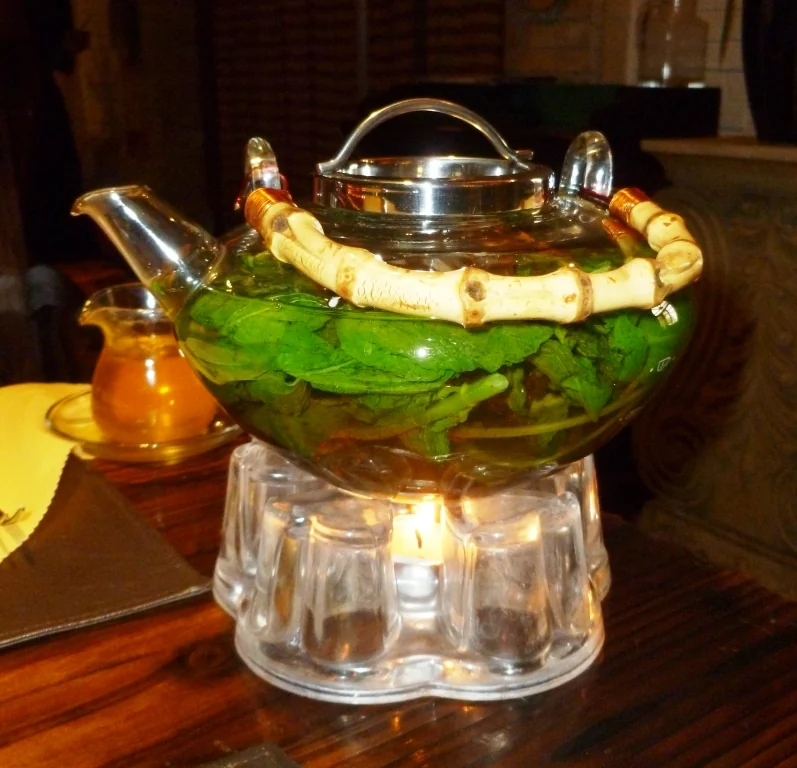
Kashgar’s teahouses are often described as places where time slows down.
The description is not entirely wrong. It is simply too easy.
Stay longer.
At first you notice kettles, tables, beams and light from the street. After a while, other details begin to matter: who takes the same seat, who enters without looking for a place, and who needs only to lift a hand before space is made.
The room is not always quiet.
People talk loudly, check their phones, leave and return, or sit waiting for someone they know.
The traveller enters the teahouse hoping to understand Kashgar.
The regular enters to see familiar people.
They occupy the same room but not the same kind of time.
The visitor still has a market, a square and another stop on the itinerary. The regular does not need to complete anything. One bowl of tea can be followed by another half-hour.
What matters is not the idea that life here is slow.
It is that some people have watched seasons and friendships pass from the same table.
The traveller stays for an afternoon.
The regulars have left part of their lives in the room.
Children Are Not Part of the Scenery
After school, the sound of the Old City changes.
Children move through the lanes with bags on their backs. Sometimes they squeeze between visitors. Sometimes they glance at a camera and keep going. They know which route leads home, which step becomes dangerous when taken too quickly, and which shopkeeper knows their parents.
Visitors need a map.
The children do not.
Adults speak about history, preservation and culture.
A child first understands the Old City as the place where growing up happens.
The meaning of a street may have nothing to do with its age. What matters is which friend lives behind which door, where it is possible to stop after school, and who will be waiting at a certain corner.
The continuation of the Old City does not depend only on whether children can recite its history.
It also depends on whether they can still have a childhood here.
A visitor may photograph a child crossing the street.
The child is not responsible for performing local life.
He is simply trying to get home.
The Square Does Not Belong Entirely to the Viewer
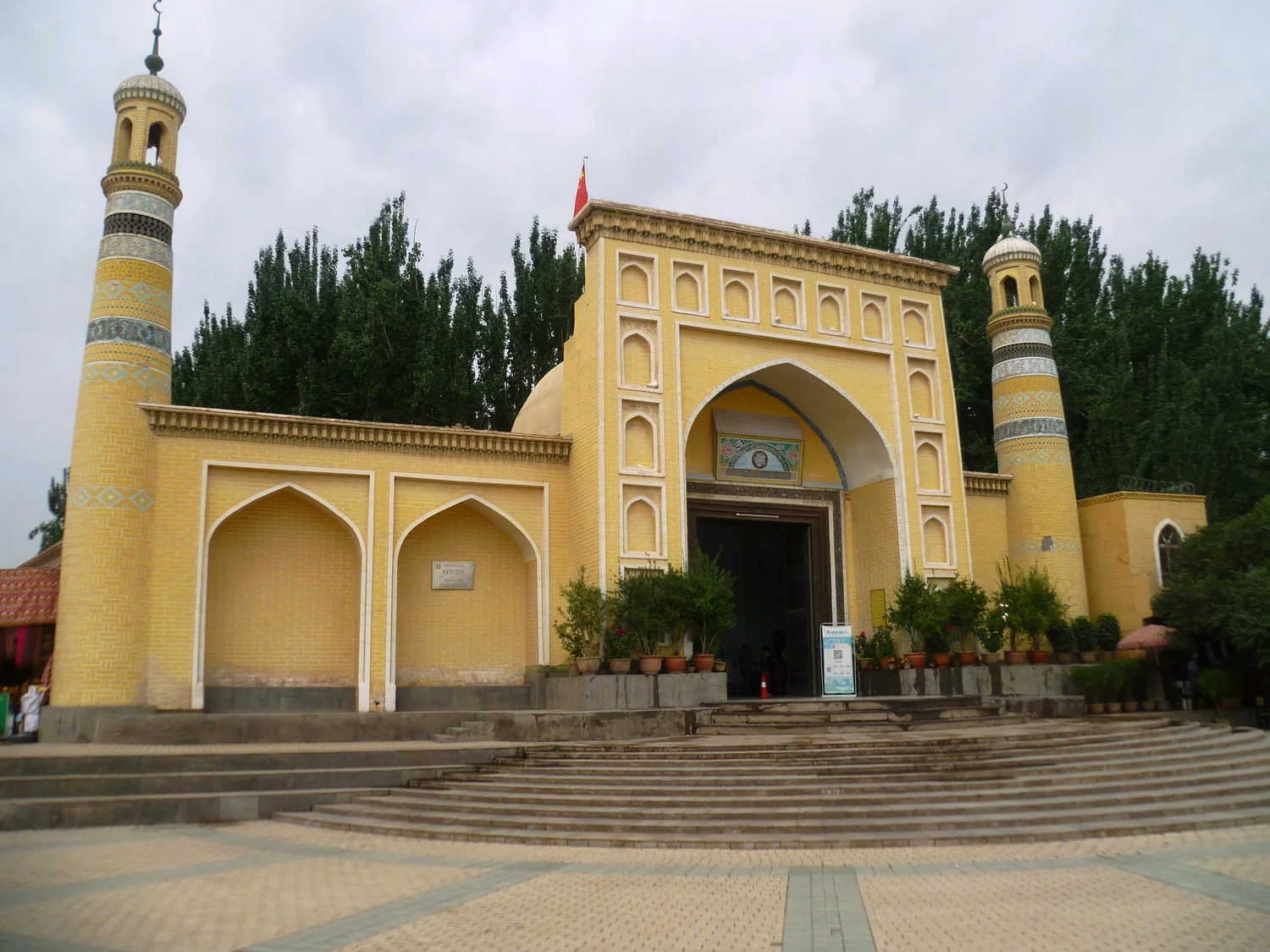
The transition from the enclosed lanes to the square outside Id Kah Mosque is abrupt.
The sky opens. Sightlines lengthen. The traveller’s attention moves naturally towards the façade of Id Kah Mosque and the scale of the public space around it.
Residents are more familiar with how the square changes through the day.
Some cross it on the way to another street. Some wait for relatives. Others rest briefly or follow a route they have used for years.
In a public and religious space that still has present-day meaning, the traveller’s most valuable skill is not interpretation but restraint.
Not everyone wishes to be photographed.
Not every gathering is a performance.
Not every part of another person’s life needs to be converted into an experience.
Sometimes respect is as simple as lowering the camera and first noticing what the people around you are doing.
Some spaces do not belong entirely to the viewer.
Accepting that does not place Kashgar farther away. It is often the first step towards seeing the city as a relationship rather than a spectacle.
At the Bazaar, Noise Is Only the Surface
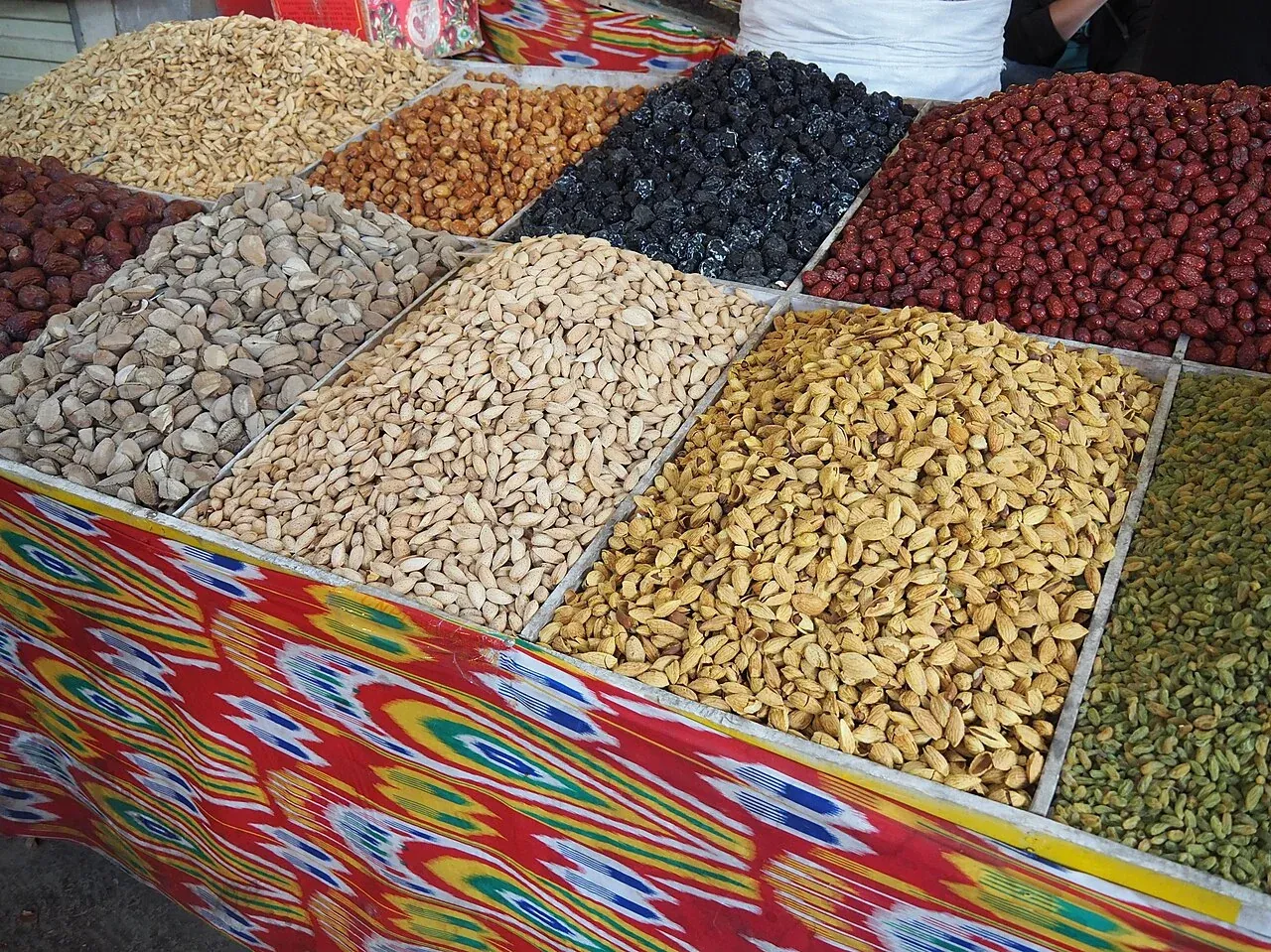
The bazaar can overwhelm the senses.
Fruit, nuts, textiles, household goods and prepared food compete with voices, prices, scooters and the movement of people. It is easy to remember only the colour and noise.
Look beyond them.
Notice who asks the price and who does not.
Watch how a trader addresses a first-time visitor and how the same person greets a customer they have known for years. See what disappears into a traveller’s bag and what nearby households buy because it is needed at home.
Human life is not a collection of colourful faces.
It exists in relationships.
A trader remembering a customer’s habits, a child knowing the next stallholder, or an older man stopping in the same place may explain more about the market than the most photogenic display.
The visitor wants to carry away a memory of Kashgar.
The trader wants the day’s income to make it worthwhile to open again tomorrow.
The two needs meet across the same counter.
There is no reason to romanticise the market. It can be crowded, repetitive and tiring. Goods are adapted to tourism. Crafts respond to demand.
What makes a market real is not an absence of change. It is that, through change, people continue to work, bargain, recognise one another and plan for the next day.
After Dusk, Who Does the Old City Belong To?
Afternoon is when visitors and residents overlap most visibly.
Towards evening, the Old City begins to recover another rhythm.
Tour groups leave. Traders bring displays back inside. Children have gone home. Seats in the teahouse slowly empty. Some people end work while others prepare for the evening trade.
A lane that looked made for photographs during the day may later hold only residents’ footsteps and the sound of shutters closing.
Walk a little farther and the Old City does not feel abandoned.
It has simply stopped explaining itself.
During the day, it is repeatedly asked to show outsiders what can be seen, understood or bought.
At night, it no longer carries that responsibility.
People go home. Traders count the day’s takings. Families eat. The craftsperson, tea drinker and shopkeeper in the visitor’s photographs return to their other identities.
They are parents, children, neighbours and friends.
They are also people who have worked all day and need to rest.
When time permits, visit once in the morning and again towards evening.
The same street will show you two different Kashgars.
Do Not Let Kashgar End at the Old City Gate
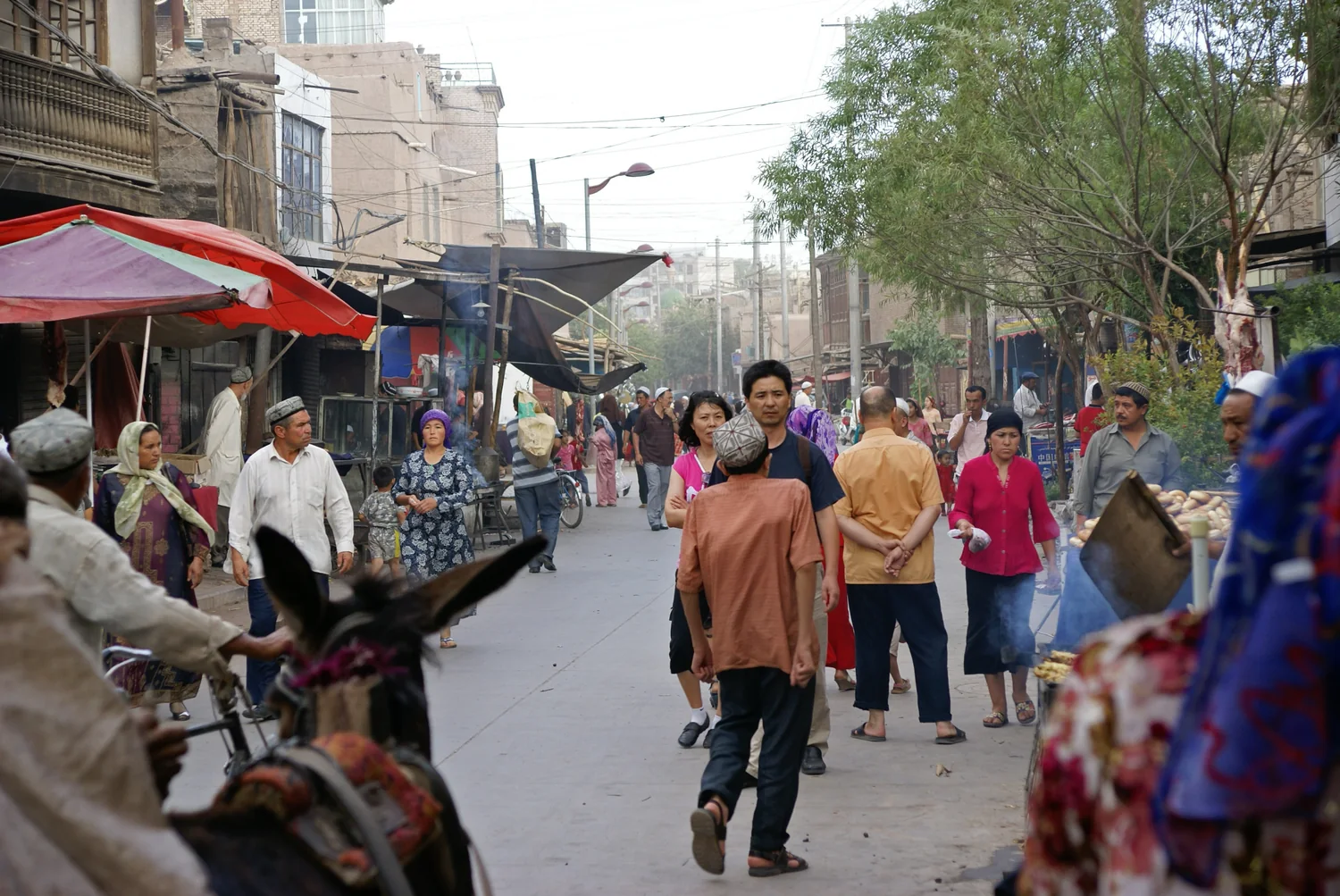
A visit confined to the Old City can leave the impression that Kashgar is defined by the past.
Beyond it, the roads widen. New housing, schools, shopping centres and workplaces come into view. Young residents shop by phone, find customers online, work elsewhere in the city and return home to the older neighbourhoods in the evening.
Some leave Kashgar to study and work in distant cities.
Some return years later.
Those who come back bring professional experience, different tastes and new ways of working. They may open bookshops or studios, enter design and online retail, or build businesses around skills that did not previously have a local market.
They are not returning to an unchanged hometown. They are negotiating with a city already reshaped by tourism, new commerce and new expectations.
Returning does not mean going backwards.
Staying does not mean refusing change.
The human story of Kashgar should not be reduced to dress, music, tea and craft. It also includes careers, women’s work, family care and the difficult question of what home means after years away.
A city is alive not only when old forms survive.
It is alive when new forms of life can find room.
The Old City is Kashgar’s most compelling entrance.
Do not mistake the entrance for the whole city.
What the Traveller Takes Away
On leaving Kashgar, travellers sort their photographs.
Doors, lanes, workshops, teahouses, the square and the bazaar are stored on a phone. The city in those images often looks still, as though the Old City might remain inside the moment when the shutter was pressed.
The next morning, the shops will open again.
Traders will carry their goods outside.
Children will take the familiar route to school.
Regulars will return to the same seats.
Some people will begin work. Some will wait for customers. Others will come back from distant cities and attempt a different kind of life here.
The traveller arrived looking for the past.
By the time he leaves, he may understand that Kashgar’s past has never remained whole and motionless in a single period.
It survives in roads and markets, in the choices craftspeople make, in family meals and in children’s routes home. It also survives in the reasons one generation leaves and another decides to return.
History continues not because buildings never change.
It continues because life still takes place within them.
Visitors leave.
Photographs remain.
Kashgar does not stop inside a photograph.
Image Credits & RightsView details
Creators, source pages and applicable licences for verified images used on this page are listed below. Images are used for editorial display on this page only, subject to the stated licence or rights-holder permission.
- Hero — Kashgar Old City (crop) | Radosław Botev / Fundacja Nomos | CC BY 3.0 PL
- Back street — Kashgar Back Street | David Stanley | CC BY 2.0
- Tea detail — Glass tea kettle, Kashgar | John Hill | CC BY-SA 3.0
- Id Kah Mosque | Radosław Botev / Fundacja Nomos | CC BY 3.0 PL
- Kashgar Bazaar | Laika ac | CC BY-SA 2.0
- Kashgar Street | ChiralJon | CC BY 2.0