
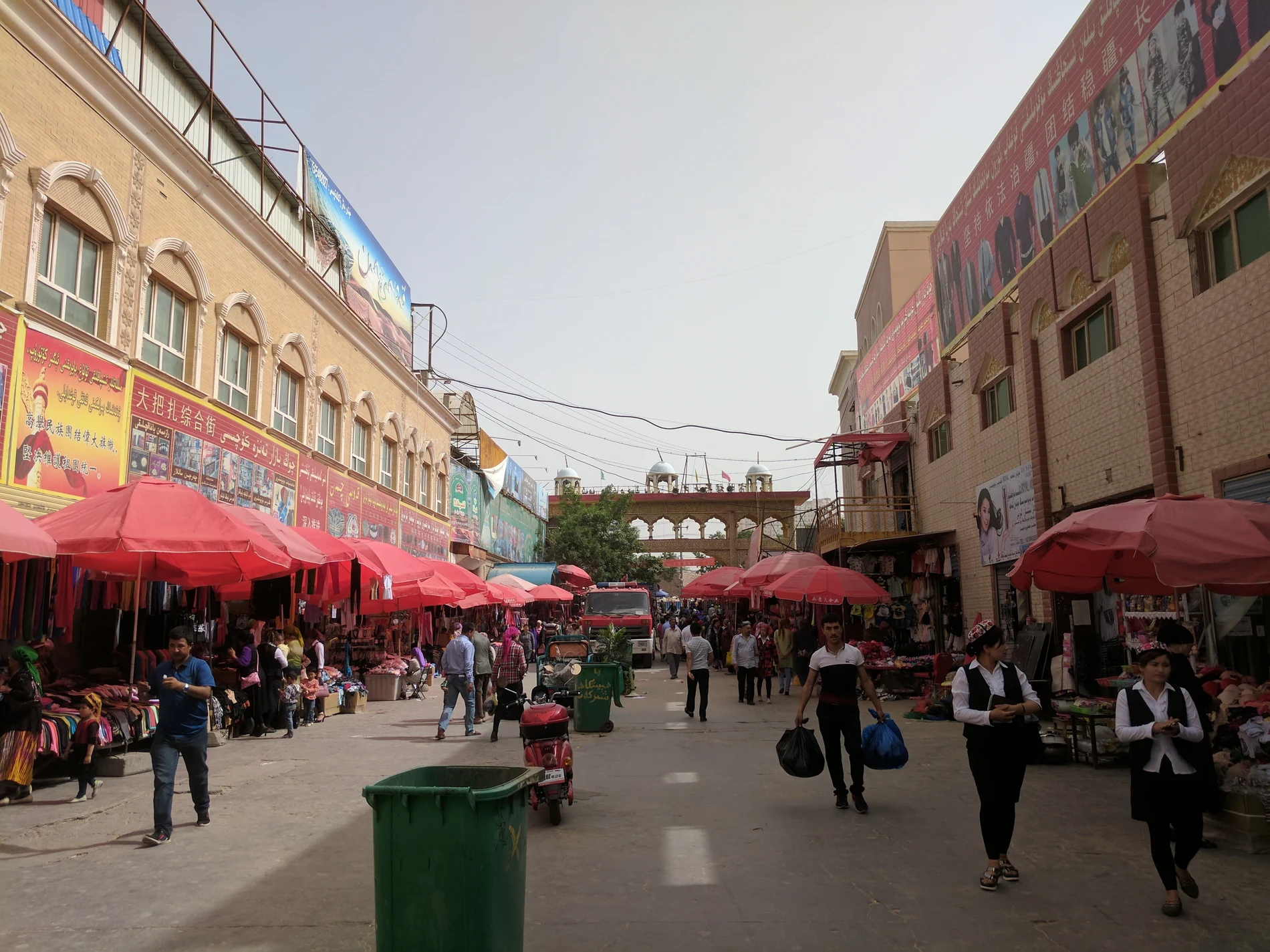
Hotan is a southern Xinjiang oasis between the Kunlun Mountains and the Taklamakan, known for jade river culture, Atlas silk, old quarters and crafts that remain part of everyday work—not only objects in a guidebook.
East of Kashgar, the map becomes increasingly spare. The Kunlun Mountains rise to the south; the Taklamakan stretches to the north. Between them, water descends from the high country and holds open a strip of land where fields, roads and towns can exist. From above, the logic looks almost too neat: where water reaches, green follows; where green lasts, people have found ways to stay.
At street level, geography recedes. Afternoon light falls hard across the road while electric scooters collect in the shade. An air-conditioning unit sits beside a carved doorway. Shops take QR payments. A schoolchild crosses the junction with a backpack hanging low. Someone drinks tea outside; someone else stops to speak to a person they know, then goes home.
A traveller arrives with names already in mind: the Kunlun Mountains, Hotan jade, the old quarters, bazaars, Atlas silk and mulberry-bark paper. Travel encourages this kind of impatience. We have come a long way, and we want to know quickly what a place is — preferably in a form that can be turned into photographs, an itinerary and a few stories to tell later.
Hotan does not resist that search. Stay a little longer, though, and the things most easily placed in a guidebook begin to slip behind ordinary life. A handsome door is first the door to somebody's home. A piece of jade is first a stone that somebody must judge, buy, sell or carve. A sheet of handmade paper exists because somebody spent hours making it. A night market may be a destination to a first-time visitor and simply tonight's dinner to the family at the next table.
We call Hotan distant. The people who wake up here do not.
Travel Intelligence · 2026
Last reviewed · August 2026Do Not Rush to Understand a City
In some of Hotan's older streets, houses are the easiest things to photograph. Doorways are worth watching for longer. A door separates household and street without cutting the two apart completely. Chairs move outside. Goods are sorted near the threshold. A neighbour stops for a conversation. A house may also be a small shop or a place of work. Children pass between homes without first needing a theory of public and private space.
Modern cities are very good at separating functions. We live here, work there, shop somewhere else, and use roads to move between them. In older neighbourhoods, life can remain less tidy. The street enters the house a little; the house spills into the street a little. People meet repeatedly because the spaces of daily life overlap.
Nothing dramatic happens in these encounters. They are not attractions and cannot easily be scheduled. Yet familiarity is often built exactly this way: first by recognising a face, later by learning a name, and eventually by knowing enough about someone's life to notice when they have not appeared for a few days.
When travelling, we meet many people once. Living in a city means meeting some of the same people again and again. That repetition may have more to do with a sense of place than any architectural style.
Tuancheng has changed. Houses have been repaired, businesses have opened, visitors arrive with cameras, and some homes now sit beside or within tourism-related commerce. It is easy, from the traveller's side of the street, to ask whether the neighbourhood still looks as it once did. But whose past are we asking it to preserve?
A house that appears picturesque during a short visit still has to survive winter. Water, heating, sanitation, ageing relatives and children growing up matter more to the people who live there than the purity of a photograph. The marks of time deserve care, but everyday life has no obligation to stop in order to preserve them for an audience.
Perhaps the most interesting thing about a living old quarter is precisely its lack of neatness: new pipes inside old walls, phones in old courtyards, visitors outside the door, dinner being prepared within. If a historic street preserves only its most beautiful surfaces but no longer works as home, what survives is a shape.
Hotan slowly encourages another kind of looking. Instead of asking only how old a building is, you begin to notice how it is being used today.
You See a Stone. Someone Else Sees Years of Experience.
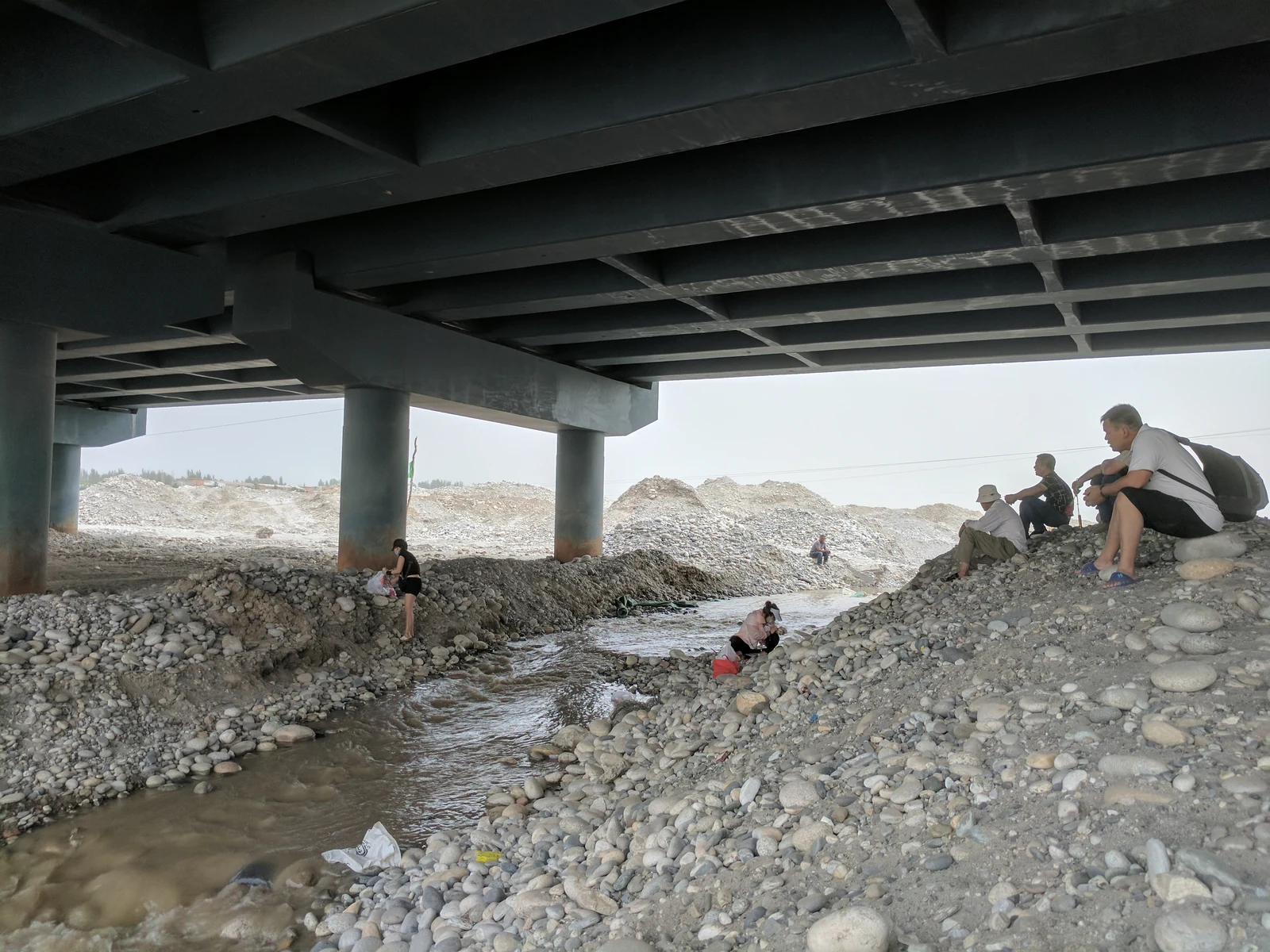
The jade trade is where a traveller may first become sharply aware of not understanding what is in front of them. Hotan jade is so famous that it can arrive in the imagination as a finished cultural symbol. In the market, it becomes specific again.
Stones lie on a table. Someone lifts one, runs a thumb over the surface, turns it towards the light and looks again. The movements are small. There may be no theatrical bargaining and no explanation for the stranger standing nearby. The stone is put down, or a conversation about price begins.
If you know little about jade, the experience produces a useful kind of ignorance. Two stones that seem similar can represent entirely different possibilities to someone who has spent years handling them. Texture, structure, cracks, skin colour, shape, what might survive cutting and what might be lost — the knowledge becomes so practised that it no longer looks like knowledge. It has moved into the eyes and hands, into the few seconds of silence after a stone is picked up.
One of travel's most interesting distances is not measured in kilometres. It appears when another person can see layers in the same object that remain invisible to you.
Once that happens, attention shifts. At first you watch the goods. Then you watch the people: who is assessing, who is waiting, who is genuinely interested, who is simply curious. Why do some stalls draw returning customers? Why does one negotiation take time while another ends quickly?
Modern retail reduces uncertainty through brands, packaging, specifications and fixed prices. Some long-running markets still depend more visibly on another asset: reputation. That does not make a bazaar inherently warmer or more virtuous than a shopping centre. Business remains business. Prices are negotiated, interests differ and people misjudge things. What the market makes visible is simply that a price tag is never the whole story.
A stone does not know what it is worth. A mountain does not price it. Value accumulates later through discovery, knowledge, comparison, craft, taste and the meanings that people attach to certain materials over time.
By then, the unfamiliar thing is no longer the jade. It is the world inside the mind of the person holding it.
One of travel's most interesting distances is not measured in kilometres.
It appears when another person can see what you cannot.
Living Things Do Not Stay Unchanged
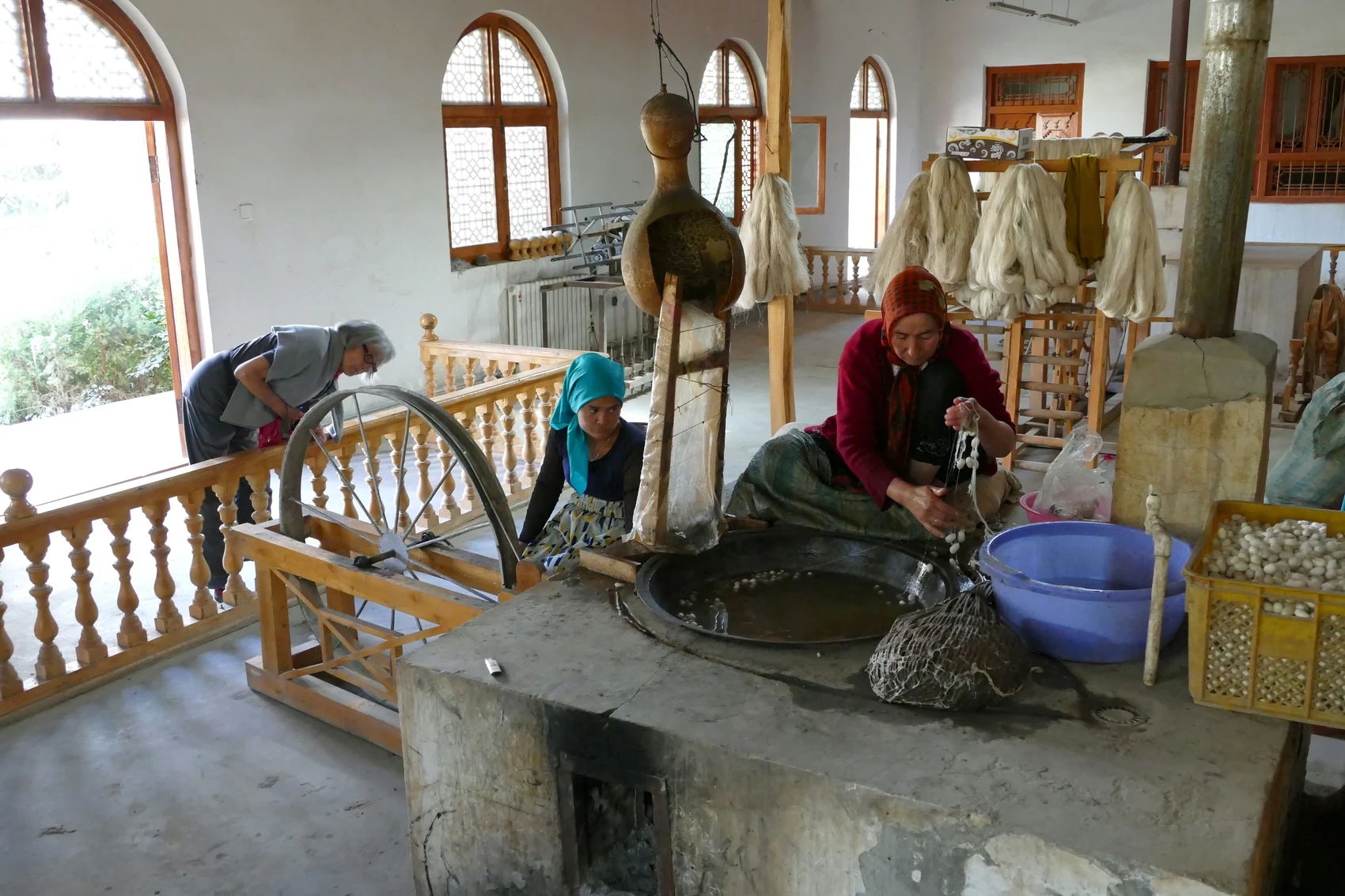
Mulberry-bark paper, Atlas silk, carpets and woodwork are easily placed under the heading of 'traditional culture'. Travel writing likes the phrase 'passed down through generations' because it makes history sound smooth: one pair of hands teaches the next, and continuity follows.
Real life is rarely that simple. A young person deciding whether to continue a family craft may be thinking less about heritage than about work. How long will it take to learn? Can it provide an income? Does anyone still want what is being made? What can change? If it changes, will people still value it? If another job offers a better life, why should tradition automatically win?
Mulberry-bark paper makes the question especially clear. Turning bark into paper requires soaking, pounding, pulping, forming and drying. Machines can produce smoother, cheaper paper with far greater efficiency. The interesting question, then, is no longer whether an old technique has been 'preserved'. It is what the paper can still do now.
New uses give old materials another route into the present. A handmade sheet can become part of contemporary design, decoration or a product its makers' grandparents never needed. Atlas silk faces the same test. Travellers see colour and pattern; the people making and selling it must also think about cutting, design, changing taste and whether someone actually wants to wear the finished garment.
A piece of cloth can now move from a loom into design software, from a tailor's hands to a phone camera, through a livestream and a logistics network, and finally to someone in a city far from Hotan. Old motions and new commerce can sit on the same worktable.
That is more complicated than the familiar phrase 'tradition meets modernity'. People living inside these changes are not staging a philosophical contest between old and new. They are solving practical problems: what is still worth making, what people will buy, what they themselves like, what needs to change.
Some things remain. Some do not. Living culture contains both loss and invention. A tradition that never changes is often easiest to find behind glass. In Hotan, the more interesting possibility is that a craft remains work — something connected to time, income, demand and choice. To be alive is also to have permission to change.
After Dinner, the Distant Begins to Feel Closer
At night, Hotan changes register. Lights come on, grills heat up and steam rises from cooking pots. Travellers search for foods they have already seen in photographs. Crowds move between stalls. When performances begin, music lifts above part of the conversation.
For a first-time visitor, the night market is naturally a destination. Sit down, however, and the more interesting scene may be at another table. A family has started eating. A child gets restless and moves between chairs. An older person eats slowly. Someone checks a phone. One diner turns towards the stage; another never looks up.
They are not necessarily there to 'experience Hotan's night market'. They may simply have decided not to cook at home.
That difference reveals something travel easily hides. The same place can carry two completely different meanings. We have crossed a long distance to be here; someone else has walked ten minutes from home. We want to remember the evening; they may return next week.
Travellers often say they want to enter local life. Local life, of course, was never waiting for us to enter it. It was already underway. For a short while, we are allowed to sit nearby.
This does not diminish travel. It makes travel more interesting. A good journey may have less to do with possessing a place — seeing enough, collecting enough, explaining it correctly — than with temporarily entering an order of life that does not belong to us.
We notice something. Misread something. Understand a little more later. Then we leave.
What Should Leave With You?
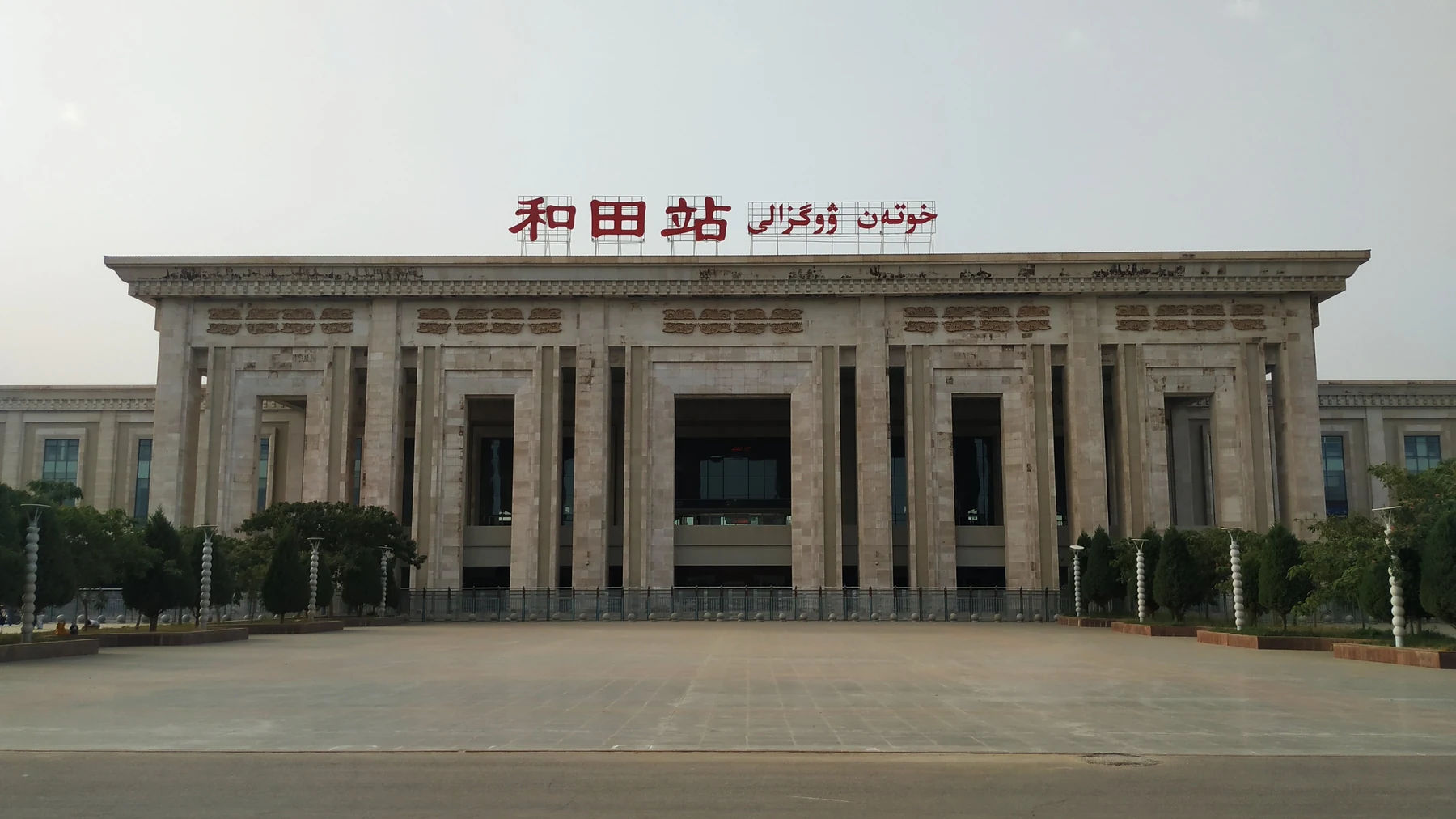
Travel makes us want to take something home. There is nothing wrong with that. In Hotan it might be a small piece of jade, a sheet of mulberry-bark paper, a length of cloth, dried fruit or photographs that may or may not be opened again months later. We like objects that prove a period of time really happened.
Occasionally, though, a journey leaves something less tangible. You may not notice it while packing. It is a change in attention.
The next time you enter an unfamiliar city, perhaps you will be a little less eager to ask what is famous. You may first notice why people keep passing a particular doorway, why the same customers return to one shop, or what years of experience are hidden in the way someone picks up an ordinary object.
When somebody calls something a tradition, perhaps you will ask not only how old it is but who still uses it, why they use it and what it has already become. When an old quarter looks beautifully preserved, perhaps you will also wonder where people bathe, how they heat their homes in winter, whether young families still want to live there.
This is not a demand that every traveller become a researcher. Most journeys are not solemn lessons. We will still take photographs, buy things, enjoy a very good meal and rush because the next departure is too early. But now and then a place quietly adjusts the way a person looks.
Hotan can do that.
The next morning, shutters rise again. Tea is put on. Goods return to the market. Children go to school. The tables from last night's market have been cleaned and will fill again in the evening. Someone will lift another stone. A phone in a workshop will receive another message. The city does not pause because a traveller is leaving.
We are the ones who begin to move.
As Hotan falls behind on the road, the word 'distant' feels less certain than it did on arrival. Distance was never a quality of Hotan itself. It was only a measurement from somewhere else.
For the people who wake here each day, Hotan is the street outside the door, people they know, today's work and tonight's dinner. Travellers are always passing through. A city has no need to become what we imagined simply because we have arrived.
But if a journey goes well, something can change in the person who passes through.
The road continues. Hotan remains where it is. Some things stay behind.
And some things leave with us.
The road continues. Hotan remains where it is.
Some things stay behind.
And some things leave with us.